Welcome to my football blog. I'll be covering most of the key issues and stories which dominate top level English and European football over the coming months, and so if you love this fantastic sport as much as I do, I hope you'll appreciate reading and responding to what I've got to say.

Monday, 28 March 2011

Welsh collapse tempers England praise

Bent's goal wrapped up the points for England after 14 minutes
It was confident. It was clinical. It was frustratingly unfulfilling.

There was much to commend about England's win at a sell-out Millennium Stadium on Saturday. The likes of Ashley Young, Darren Bent and Scott Parker all showed signs that they are finally feeling at home wearing the three lions, while Jack Wilshere offered further proof that he is not merely the future of the national team, but rather a key part of its present.

John Terry produced the kind of dominant and uncompromising display which lended weight to the arguments of both those who agree with Capello's decison to reinstate him as captain and those (like myself) who are of the view that he should never have been parted from the armband in the first place.

Capello's experimental 4-3-3 formation was also a pretty unqualified success, thanks in large part to prudent choice of personnel - the discipline of Parker allowed the more creative instincts of Wilshere to roam unchecked, while the attacking disposition of full-backs Cole and Johnson ensured England never lacked for width.

Above all, it was the steely resolve with which England took to their task in the opening moments which most impressed. In an intensely hostile atmosphere rife for intimidation, the visitors remained unbowed, and ruthlessly dispatched their opponents inside the first 15 minutes.

From the moment Darren Bent followed Frank Lampard's confidently taken penalty by sweeping home Ashley Young's cross, England never looked anything other than home and dry. The intensity among the players dropped off as they sensed victory; an instinct for self-preservation emerging as some of the Premier League's big names took the opportunity to conserve energy for crucial club battles ahead.

The only bum note struck from then on was the stupid booking picked up by Wayne Rooney for a needless foul on Joe Ledley, which rules him out of Switzerland's visit to Wembley in June.

But even that may eventually play out to England's advantage, for Capello will fancy his side's chances of seeing off the uninspired Swiss even without his star man, and suspension may grant Rooney the summer break he seemingly needs to emerge fit and firing from the most frustrating twelve months of his career to date.

After the bright opening in which the game was won, it was, in essence, a walk in the park for England. And that is the problem.

For the bottom line, harsh though it is, is this: England won convincingly and impressively, but against an opposition who were so passive, so toothless, so devoid of quality of any kind that it rendered the achievement almost insignificant. But it could have been so different. 

Gary Speed's young Wales team had a rare opportunity on Saturday. It was not simply a matter of pouring misery on 'the old enemy' in front of legions of their countrymen and heaping the pressure on Fabio Capello at the end of a week in which his stock had fallen even further with his ham-fisted treatment of the captaincy saga.

It was a matter of reassuring the Welsh fans after a disastrous start to Euro 2012 qualification that there is, after all, reason to be optimistic for the future of their national team.

It was a test which should have been a cause for Welsh inspiration; instead, it bred self-destruction - first through James Collins' clumsy hack on Ashley Young after the big centre-half had been caught badly out of position, and then through defensive organisation which wouldn't have looked out of place on the school playground as Darren Bent gleefully tapped home his third - and simplest - international goal.

Aaron Ramsey looked overburdened by the responsibility of captaincy in what remains early days after his horrific leg break last year. A bad combination of ring-rusty and overly-ambitious in possession, he toiled gamely throughout, but to no avail. There is little doubt the 20-year-old will grow into his new role, but a home nations grudge match against England was always likely to prove a baptism of fire.

And while much was made pre-match about the absence of Gareth Bale through injury, it is unlikely that Spurs' flying winger would have been able to significantly affect its outcome, no matter how devastating he has looked this season. That he would have significantly enhanced the threat of the Welsh attack is undoubted, but must also be tempered with the knowledge that the defence would have been no less porous in the face of English pressure.

If Gary Speed was under any illusions as to the size of the task facing him with the Welsh national team, he is perfectly aware now.

Out-thought, out-fought and out-played in each of their first four group matches and with their dreams of qualification already dead, the 41-year-old must now rebuild this young team's fragile confidence and try to create a new mood of optimism in the group before the race for Brazil 2014 begins. On recent evidence, it will be a long, hard road.

There is of course, the argument that England forced their opponents to play badly through superior organisation, pressure, and work rate. It is has an element of truth to it.

But Wales are a team ranked 116th in the world by FIFA. They had lost their opening three qualification games prior to Saturday's clash, and their starting XI was one which, aside from a few notable exceptions, consisted of players plying their trade in the football league. Such a team would require no great encouragement to play badly from the group of established Premier League names Fabio Capello was able to field. And, as it turned out, they didn't.

Victory at the Millennium Stadium, and the manner in which it was achieved, does not even consitute the best performance of England's qualification run thus far. Both the demolition of Bulgaria at Wembley last September and the triumph over Switzerland in Basel four days later were more comprehensive scorelines over teams vastly superior to Wales.

Those results failed to capture the public imagination for two reasons: firstly, because the games followed hot on the heels of the disappointment of South Africa and were achieved by largely the same team which had been responsible for it; and secondly, because any progress thought to have been made in those matches was quickly exposed as another false dawn by frustrating stalemate at home to Montenegro a month later, followed by a friendly defeat to France which was far more comprehensive than the 1-2 scoreline suggested.

Of course, there is plenty to suggest genuine progress is being made this time. Half the players in the squad Capello picked to face Wales were not involved at the World Cup.

Moreover, these new faces have not just been included to make up the numbers - Hart, Dawson, Wilshere, Young and Bent are making compelling arguments to become permanent components of the spine of the team, and it is to be hoped that the likes of Parker, Carroll and Adam Johnson can go on to do the same in the coming weeks and months.

But it is frustrating that Fabio Capello's brave new faces were not significantly tested on Saturday, and that the match could not tell us anything substantial about whether they or the tactics employed could work against more formidable opposition.

Perhaps Ghana at Wembley on Tuesday, friendly though it is, will provide a better indicator. What is certain, however, is that sterner examinations must be passed by Capello and his men if England fans are truly to be convinced that better times lie ahead.

Sunday, 20 March 2011

Champions League battle lines drawn

The Champions League quarter final draw conjured some intriguing ties
After all the backslapping, lovingly artful montages and tired you-have-all-earned-the-right-to-be-here-but-there-are-no-easy-matches-at-this-stage clichés had finally been dispensed with, UEFA General Secretary Gianni Infantino welcomed Gary Lineker on stage at the organisation's lush headquarters in Nyon, Switzerland, and got on with the business at hand.

The representatives of each of the remaining eight clubs in this year's Champions League looked on with baited breath, waiting to find out exactly what will be required if they are to emerge victorious at Wembley in May.

Now they know. As for the draw itself, it may have been a while in coming, but it was certainly worth the wait.

Both Ferguson and Ancelotti are looking for their third Champions League triumph
First up, its Chelsea versus Manchester United in a tie which is pure box office. Not only is it a rematch of the epic 2008 Champions League final in Moscow, it is also a duel between two genuine powerhouses who have, between them, dominated English football for the past six years.

Both sides will feel entitled to fancy their chances. United have been victorious on each of the previous four occasions they have been drawn against English opposition in the Champions League, and there are few coaches quite as experienced in Europe’s premier club competition as Sir Alex Ferguson.

But in Carlo Ancelotti, Chelsea can also boast a manager with considerable European pedigree. Roman Abramovich brought the 51-year-old Italian to Stamford Bridge 18 months ago primarily in the hope that Champions League success would soon follow.

That hope was dashed by Mourinho’s Inter last year, but victory over United in the league earlier this month has spread cautious optimism throughout the Chelsea ranks that Wayne Rooney and co. will not be the ones to end their European dreams this time around.

If Chelsea are to see off the threat of United, it will have to be without January arrival David Luiz, the star of that league win and the man who incurred Sir Alex Ferguson’s wrath for his unpunished manhandling of Wayne Rooney, as the fuzzy-haired Brazilian is not eligible to participate in the remainder of the Blues’ Champions League campaign.

However, potentially even more decisive for the outcome of the tie are the absentees in United’s defensive ranks.

The success which has enabled Ferguson’s latest generation to lavish an impressive collection of trophies upon the already creaking trophy cabinet at Old Trafford over the last four years has invariably had the imperious defensive partnership of Ferdinand and Vidic at its foundations.
 
This season, with the England captain struggling with persistent injury problems, it has fallen to Vidic to assume the sole responsibility of marshalling the Red Devils backline. It is a challenge he has risen to magnificently, putting in consistently match-saving performances as an infrequently convincing United have fought to maintain their place at the head of the Premier League title race.

All of which makes the inspirational Serb’s potential absence from the first leg at Stamford Bridge through injury a grave concern for Sir Alex. With Rafael and John O’Shea also out, United’s likely alternative – the promising but inexperienced pairing of Chris Smalling and Jonny Evans at centre-back and Wes Brown guarding the right flank – is not likely to intimidate even Chelsea’s misfiring attack.       

If Vidic does not take to the field at Stamford Bridge on 6th April, Chelsea will have an invaluable opportunity to take a big step towards the Champions League semi-finals. That said, Carlo Ancelotti’s men will have to overcome themselves before they can defeat their illustrious opponents.

Only in the last few weeks have the green shoots of recovery started to emerge in West London, after three months of relegation form which all but eliminated the possibility that the Premier League’s current champions will still be so come May. But despite recent signs of improvement, the Blues are still a long way from what will be required if they are to finally claim the trophy their owner so desperately desires.

One thing is certain: Chelsea’s revival needs to be swift. There is no hiding from the fact that Manchester United usually win at home when it really matters, and so Ancelotti’s side will likely not be able to settle for anything less than a victory in the first leg. If Ferguson’s men are able to take a positive result or an away goal back to Manchester, they will fancy their chances of seeing off their rivals while being roared on by a capacity Old Trafford crowd.

In any case, the team which emerges victorious from the tie will surely fancy their chances of featuring at Wembley in May, having been drawn to face the winner of Inter and Schalke in the semi-finals.

Inter Milan are the likely opponents for Chelsea or United in the semi-finals
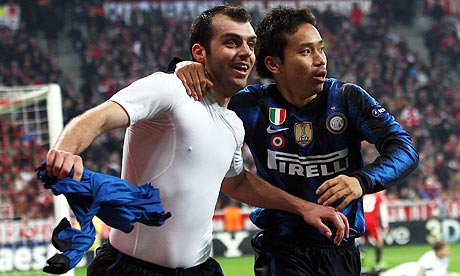
The Italian giants have surely used up their allotment of fortune in defeating Bayern Munich in what was arguably the outstanding match of the last round. To their credit, Leonardo’s players also showed great resilience to come back against the Bundesliga champions after a first half in which they conceded enough chances to lose several matches.

This Inter are, however, simply not the same team as the one which swept all before them last season under Mourinho, even though most of those players remain. They are rightly favoured to defeat Schalke over two legs and advance to the semi-finals, but unless drastic improvements are made, both Chelsea and United would likely have the measure of the Serie A champions.

In fact, Inter's defensive vulnerability is such an issue that it would be foolish to rule Schalke out, and the Germans' impressive dispatching of an in-form Valencia side in the last round is proof enough of their capability to cause an upset.

But the Gelsenkirchen-based club appear to be in a state of crisis. Their wonderful achievements in Europe represent the only positive in an otherwise disappointing campaign which currently sees them languishing in 10th in the Bundesliga. 

Coach Felix Magath has already paid for this underachievement with his job, and although there is likely to be a new man in charge by the time the quarter-finals commence, the gut feeling is that Schalke may well find themselves out of their depth against the reigning European champions.

Rafael Van der Vaart will face former club Real Madrid in the quarter-finals
While it was the meeting of Chelsea and Manchester United which has got the most column inches in the national newspapers, it is the prospect of Tottenham facing up against Real Madrid which arguably does more to excite the imagination. 

Harry Redknapp's side are statistically the most exciting team to watch in the Champions League this year - there were, on average, five goals in each of their matches in the group stage - and although they showed a more conservative side against AC Milan in the last round, any team with Modric, Bale and Van der Vaart in its ranks will have no shortage of attacking intent. 

Spurs' impressive feat in claiming the scalps of both Milan giants also shows that, while this may be their first ever campaign in the Champions League, they are not intimidated or overawed by big names or reputations. It is a quality they will need again in spades - for as reputations go, they don't come bigger than Real Madrid. 

By pairing two of the most attack-minded teams left in the tournament, the the quarter-final draw has set up a mouthwatering new chapter in Tottenham's European adventure. It has also set up comfortably their stiffest test so far. 

Jose Mourinho's Real Madrid are an outstanding side. Prior to their 5-0 mauling at the hands of Barcelona, they were widely regarded as the second best football team on the planet. And although the praise has been slightly more reserved since then, Real remain a team consisting of world class players almost in every position, directed by the greatest tactician in the game. 

But they are far from invincible. For while the centre-back pairing of Ricardo Carvalho and Pepe has remained largely solid this term, the latter is occasionally prone to positional errors and bouts of indiscipline. Then there is also the fact that full-backs Marcelo and Sergio Ramos, for all the attacking threat they carry down the flanks, can occasionally be caught out defensively - a weakness which Gareth Bale and Aaron Lennon will surely look to exploit. 

Madrid are also, somewhat inevitably, over-reliant on Cristiano Ronaldo. The Portuguese superstar has scored an astonishing 37 goals and chalked up 12 assists in 42 appearances this season, but a hamstring injury threatens to keep him out of the first leg at the Santiago Bernebeu on 5th April. 

Ronaldo's absence could be crucial to Spurs' hopes of ensuring the tie is still alive when Real come to North London two weeks later. If they succeed in doing so, expect White Hart Lane to be rocking in anticipation of another great European night.

Even in the event that Harry Redknapp manages to best Mourinho - something he has so far failed to do in five attempts - Spurs' path to the final is likely to be blocked by the beautiful yet devastating presence of Barcelona. Well, unless Shakhtar Donetsk can achieve the mother of all upsets.

Are Shakhtar the team to derail the Barcelona juggernaut?
The Ukrainian champions are the ones unlucky enough to be facing the "side to avoid" in Friday's draw. But it may be surprising to learn that Pep Guardiola and his "dream team" are not overly keen on the prospect of facing Shakhtar either.

You see, Mircea Lucescu's men have previous with the Catalans. Paired together in the group stage of the 2008/9 tournament, Barca were made to work incredibly hard for a controversial win in the Ukraine before Shakhtar claimed a shock win in the Nou Camp. And, given that the personnel on both sides has changed little in the last two years, you can see why the La Liga champions are fearful of history repeating itself.

A two-legged tussle against Shakhtar entails a long and arduous trip to Eastern Europe and back for Barca, just at the moment when big games are coming thick and fast for them. Not to mention the fact that the Ukrainians are approaching the tie fresh from a pre-season break, whilst their opponents have been playing high-intensity football for over six months.

The caveat to all of this, of course, is that we must remember just how good Barcelona are. Shakhtar must journey to Spain for the first leg of the tie, and will have to travel better than they did against Arsenal in the group stage, when they were soundly thrashed 5-1. Messi and co. are more than capable of blowing Lucescu's team away at the Nou Camp and making the second leg a dead rubber.

But if they don't, things may just get interesting.

Sunday, 27 February 2011

Napoli emerging from Maradona's shadow


The 26th April 1990 is a day that will forever be celebrated in the city of Naples.

For it was on this day that tens of thousands of proud Neapolitans flocked to the city’s historic San Paolo stadium to watch a team of their heroes, inspired by its captain – a certain diminutive playmaker from the slums of Lanus, Argentina – defeat Lazio to secure only the second Serie A title in the club’s history.

The captain, of course, was Diego Maradona. In a six-year spell which would prove to be the zenith of an illustrious career for club and country, this flamboyant genius transformed S.S.C Napoli from the sleeping giants of Italian football into one of its leading lights and, in the process, firmly established himself in the pantheon of the game’s all-time greats.

Maradona’s achievements in the south of Italy tend to be overlooked in the light of his World Cup exploits. But he will forever be the darling of Naples because, to put it simply, Maradona IS Napoli – there is perhaps no other football club in the world whose history and identity is so dominated by a single player.

This is in part because Napoli’s achievements are almost entirely Maradona’s achievements: the Partinopei’s two Scudetto triumphs, one Coppa Italia victory and sole European success – the 1989 UEFA Cup – all came during the Argentine’s time at the club.

But there is more to it than that.

Maradona’s connection to the Neapolitan community runs deeper than simply the trophies he lavished upon them. He was not just the symbol of a club and a city; he was the physical embodiment of the spirit of its people – an icon who warranted the kind of reverence usually reserved for the Pope and the Virgin Mary.

Dave Taylor, an Italian-based journalist writing for Football Italia magazine, explains the relationship in the following terms:

“He [Maradona] was loved immediately on his arrival. He was every mother’s son, everyone’s brother, every girl’s boyfriend. He was the man who would show the world that Napoli could and would teach everyone else how to play football. Apart from his calcio skills, his social importance was of enormous benefit to people’s self-esteem and he soon became an idol of the people.”

What has enhanced Maradona’s legacy at Napoli arguably more than anything else in the last twenty years is the swift decline the club endured following his departure in 1991.

The financial problems which plagued the Neapolitan club throughout the 1990s – a direct result of the lavish spending which had brought galacticos such as Maradona, Careca and Ferrara to the club in the preceding years – resulted in several self-imposed exiles from Italy’s top flight, culminating almost inevitably in a formal declaration of bankruptcy in 2004.

The football club plunged briefly out of existence, only to be resurrected by Neapolitan film producer Aurelio De Laurentiis, nephew of the late Hollywood producer Dino. Napoli Soccer, however, as they were now known, would have to start from scratch in the third tier of Italian football, and it looked as if the glory days were well and truly over.

Instead, relegation has proved a blessed rebirth. Over the last six years, De Laurentiis has presided over a sustained rebuilding program which has seen Napoli regain its name and history, work its way back up the domestic footballing ladder and re-establish itself as a fixture at Italy’s top table.

And this season it looks set to get even better.


With two-thirds of the Serie A season gone, the Neapolitans find themselves second in the table, three points behind leaders AC Milan and two points clear of last season’s all-conquering Inter. How did this happen?

Admittedly Napoli, together with the likes of Palermo, Sampdoria and Genoa, has benefited from the slow but steady decline of Serie A over the last decade.

A combination of financial mismanagement, comparatively poor television revenue and the economic fallout from the 2006 Calciopoli scandal has impeded the ability of Italy’s biggest clubs to consistently compete with the giants of the Premier League and La Liga for the world’s top players – thus levelling the playing field and opening the door for some of the country’s more conservatively-run clubs to upset the established domestic order.

But ultimately the credit for Napoli’s remarkable rise belongs to the club and the club alone. De Laurentiis’ policy of signing young talent rather than established names has proved prudent on a footballing as well as financial level. It has helped craft a young and dynamic team, possessed not only by lofty ambitions but also the hunger to achieve them.

Of course, having the league’s top scorer helps: Edinson Cavani, the big Uruguayan loaned from Palermo in the summer, has made a mockery of his previously indifferent scoring record by banging them in for fun this term – his Serie A tally currently stands at an impressive 20 goals in 26 appearances, and this golden touch in front of the net has made him such a hit with the San Paolo faithful that they have even named a pizza after his nickname – El Matador.

Cavani has undoubtedly benefited enormously from having little Ezequiel Lavezzi buzzing around him. The Argentine has only netted four times in the league this season, but his ten assists are a truer reflection of his invaluable contribution. He, like the rest of Naples, worships Maradona, and his performances have at times evoked fond memories of “the Great One” in the minds of Neapolitans.

Finding the openings for this red-hot partnership is Marek Hamsik. The 22-year-old Slovakian is rated as one of the finest young playmakers in world football, and his excellent form this season proves him worthy of such praise. In addition to his creative gifts, Hamsik has also averaged just over 10 goals in each of the last four Serie A seasons – which, achieved against the notoriously stingy Italian defences, is no mean feat.

But Napoli’s unexpected title challenged owes just as much to defensive as to attacking qualities. Their backline, superbly marshalled by Italy’s former World Cup-winning captain Fabio Cannavaro, is the second stingiest in Serie A, having churned out a peerless 14 clean sheets along the way. And with promising young Spanish centre-back Victor Ruiz having further bolstered the defensive ranks in January, the Partinopei are not likely to become easier to break down any time soon.

Key to the excellent balance Napoli has achieved between attack and defence this season has been through clever use of the flanks.

Manager Walter Mazzari employs Colombian Juan Camilo Zuniga in the left and the less exotic Christian Maggio on the right of a 3-4-1-2/5-2-1-2 formation, depending on whether or not his team has the ball. This tactic flies in the face of the tendency of many Serie A teams to play very narrow in the midfield, and on many occasions this season the Neapolitans’ ability to maintain width has afforded them a vital extra dimension to their play.

It is inevitable for a club of Napoli’s stature that spectacular overachievement invariably leads to star players becoming the subjects of attention from Europe’s elite clubs – the outstanding trio of Cavani, Lavezzi and Hamsik have all been linked with big money moves to England next summer – but De Laurentiis is adamant that turning Napoli into a selling club never has been, and never will be part of his plan.

Speaking at the start of the season, he said:

“Napoli wants to grow together with its talented players. We don’t sell players who are integral to our plans, we sell players who don’t fit in.

I’ve read that [Sir Alex] Ferguson would like to buy Hamsik and Cavani for €40m and I started to laugh. Unfortunately, many people don’t realise that it is important to keep your best players to be able to become champions.”

What’s more, it is clear from the actions of Napoli’s outspoken chairman that his insistence that his club can once again become “champions” is not merely idle talk.

Current Lazio manager Eduardo Reja led the Neapolitans to a rapid return to Serie A following bankruptcy in time for the 2007/08 season, but was shown the door the following year after falling out of contention for a UEFA Cup spot. Reja’s replacement, former Azzurri coach Roberto Donadoni, was also booted out after a few months in favour of then-Sampdoria manager Mazzari when results were deemed unsatisfactory.

In the long term, De Laurentiis expects seasons like this one to become the rule rather than the exception. And despite his financial conservatism, he is willing to spend in order to make it happen.

“Neapolitans must be calm, because I am working for the future and not for today,” he said.

“If [sporting director] Pierpaolo Marino finds us a great signing, I will go for him. I will put my hand in my pocket and pay for the player.”

So can Napoli fulfil their owner’s dream and win Serie A this year?

Their relative lack of title-challenging experience and squad depth suggests they might just come up short against one, or both, of the Milan giants. On the other hand, Mazzari’s young players have already shown they have enough fighting spirit to remain in the title mix until the very end – just under 40% of their goals this season have come in the last 15 minutes of matches. Time will ultimately be the judge.

Perhaps a more realistic prospect this season is securing Champions League football. With Napoli enjoying a four point lead over the chasing pack, a place in Europe’s premier club competition is beckoning, and the benefits would be enormous.

Not only would it provide a powerful incentive for the likes of Cavani and Hamsik to commit their long-term futures to San Paolo, it would also give the club a platform to establish itself as one of Italy’s big players for years to come.

Long-suffering Neapolitans have clung to that glorious spring afternoon in April 1990 for over two decades. Now, at long last, they have a team capable of creating new memories for them to cherish, and proving, after all, that there is life after Diego.

Saturday, 19 February 2011

Arsenal and Spurs show their mettle


The Champions League roared back into action this week, as Tottenham and Arsenal produced performances of the very highest quality to deservedly claim the scalps of two of European football's giants. 

In doing so, they delivered the most emphatic riposte possible to those who like to claim that the steady migration of top talent to Spain in recent seasons has eroded the Premier League's status as the strongest in the world.

For while there may be an argument that Chelsea and even Manchester United have been weakened slightly in that period, there are currently more teams in this country capable of challenging Europe's elite than perhaps at any point in the history of the Premier League - a fact made evident by the fact that two of our top flight's chasing pack have just beaten the champions-elect of La Liga and Serie A.

Perhaps inevitably given the pedigree of their opposition, both Spurs and Arsenal went into their European ties widely regarded as underdogs. 

After all, Harry Redknapp's side were charged with taking on an AC Milan side staring down the barrel of their first Scudetto since 2004 in one of the most intimidating stadiums in world football - and without either Gareth "Scourge of Maicon" Bale or a fully fit Luka Modric.

Arsene Wenger, for his part, could be forgiven for having limited sympathy with his North London rivals, having drawn Barcelona - last season's conquerors, the La Liga champions and a team of such exceptional quality that their fiercest competition appears to be coming from the footballing annals of history rather than the pitches of the present.

But rather than wilt in the face of the challenge, both English sides arguably produced their most mature displays of the season.

Much of Spurs' success this term has been built on their ability to overwhelm their opposition in the final third, utilising the pace and direct running of Bale and Lennon on the flanks, the creativity of Modric and Van der Vaart in the middle, and the physicality of Crouch up front. 

Their expansive approach has made Harry Redknapp's side compulsive viewing in Europe this season, but it has often left them defensively vulnerable - never more so than on their last visit to the San Siro to face Inter, when a brilliant second half hat-trick from Gareth Bale papered over the cracks of a torrid first half defensive display.

And so, with Redknapp still perhaps sensitive to the sting of that particular defeat, Spurs this time set out to defend deep from start to finish, allowing Milan to have possession in safe areas and looking to use the pace of Lennon to land a sucker punch on the counter-attack.

The Italian giants were too slow and laboured on the ball to break down the organised Spurs defence, marshalled by a superb Michael Dawson, and the glamorous duo of Robinho and Ibrahimovic were never more than peripheral figures. Even on the rare occasion the Spurs defence was breached, the hosts found themselves confronted by Heurelho Gomes in world-class form.

When all attempts at incision failed, Milan resorted to blatant provocation of their opponents - led by Mathieu Flamini, who should have been sent off for a horrible two-footed lunge on Vedran Corluka, and captain Gennaro Gattuso, who could feasibly have acquired more cards than Clintons' in the 90 minutes he astoundingly remained on the pitch.

Spurs' level-headed response was to regard the Italians' anger as a compliment to the success of their approach rather than an invitation to retaliate, and their patience was rewarded with a superb goal ten minutes from time: Aaron Lennon showing blistering pace to leave several Milan defenders in his wake, and then remarkable poise to pick out Peter Crouch, who must have been delighted that the most important goal of his career was also one of the simplest.

In defeating Milan on their home turf, Spurs have shocked the footballing world for the second time. The first - the destruction of Inter at White Hart Lane in November - was impressive because it proved Harry Redknapp's team possess the talent to compete with Europe's best. The second is equally significant because it confirms they also possess the determination to do so. 

But of course, Tottenham weren't the only ones to shock the footballing world this week. In fact, they weren't even the only ones in North London.


In a match almost the entire footballing planet was watching, Arsenal produced a stirring second half comeback against Barcelona to save themselves from Champions League oblivion and even give their fans hope of pulling off an unthinkable upset over Pep Guardiola's "Dream Team".

Even more surprising than the result was the method by which it was achieved. Barcelona are universally acknowledged to be the best footballing team in the world, and consequently it was believed that any team foolish enough to attempt to outplay them would be doomed to failure. 

It is a theory which has been widely accepted in the wake of Barca's beautiful destructions of Arsenal in last season's Champions League and of Real Madrid in last November's Clasico. But it is false.

Of course, no one in their right mind would claim that Arsenal played Barcelona off the pitch on Wednesday evening. But they stayed true to their attacking philosophy - Arsene Wenger is too much the footballing purist to ever attempt the perceived "anti-football" employed by Mourinho's Inter at the Nou Camp last year, for better or worse - and it was these attacking instincts which underpinned the Gunners' remarkable comeback.

In order to stay true to their identity, the Arsenal players knew they would have to absorb considerable punishment against the possession kings of world football. They remained dogged in the face of prolonged periods chasing shadows, and even sucked up the body blow dealt by David Villa's opener - a work of surgical precision as much as beauty.


They also rode their luck at times, on several occasions relying heavily on Lionel Messi's uncharacteristic profligacy in front of goal to remain in contention. But in coming back from a goal down against such exceptional opposition, Arsenal managed to ally sheer determination and mental toughness with the technical excellence more regularly associated with their game.

This attitude was epitomised by Jack Wilshere who, at 19 years of age, more than held his own against perhaps the greatest midfield in history, and seemed completely unfazed by the occasion. 

It is an understatement of monumental proportions to herald him simply an exceptional young prospect. By demonstrating such poise and ability at the highest level and at such a young age, Wilshere has shown he has the potential to become the greatest midfielder England has ever produced.

Of course, Barcelona had a hand in their own downfall. They were guilty of not finishing off the game despite creating more than enough chances - a criticism with which Arsene Wenger will certainly empathise. The decision to bring on Seydou Keita for the dangerous David Villa also surrendered the initiative precisely at the moment when Pep Guardiola's side needed to keep control.

However, while the Spanish giants may have left the door ajar for Arsenal, the Gunners still deserve all the credit they have received for being able to walk through it - not only did they drive their illustrious visitors back through sheer force of will, but Robin Van Persie and Andrey Arshavin took their chances brilliantly.

Ultimately when all is said and done, what do these results actually mean for two of the Premier League's finest?   

Harry Redknapp will certainly be mindful of the fact that a team of Milan's quality can never be counted out. The Italians are unlikely to play so poorly again, and the mercurial duo of Robinho and Zlatan Ibrahimovic are more than capable of ending Tottenham's European adventure if afforded time and space. 

That said, Spurs now carry a priceless lead into the home leg in three weeks' time, where they will hopefully have Bale, Modric, and what will undoubtedly be an electric White Hart Lane atmosphere to spur them on to victory. They are now firm favourites.

For Arsenal, much, much work remains. Arsene Wenger will remember all too well what Barcelona are capable of at the Nou Camp, and that David Villa away goal remains a significant cause for concern. Then there is also the fact that Lionel Messi does not have too many bad days, and may have used up his quota at the Emirates.

But unlike last year, Arsenal have a lead - albeit slender - to protect, coupled with the belief that they can beat the Champions League favourites. Key to their gameplan in the Catalan capital will undoubtedly be the searing pace of Theo Walcott, who ran Maxwell ragged in last season's fixture. Gunners fans will hope his contribution will be even more decisive this time around.

Whatever the future holds, keep the evenings of the 8th and 9th of March free in your social calendar. If the contests at White Hart Lane and the Nou Camp yield anywhere near the amount of drama and quality this week has delivered, we are in for quite a treat.

Wednesday, 2 February 2011

Clubs roll the dice on deadline day


On Monday - against the backdrop of a national austerity drive of unprecedented scale - came the most expensive and enthralling transfer deadline day ever, as the owners of two of the Premier League's troubled giants laid their cards (and their cash) on the table.

Chelsea's reclusive and volatile owner Roman Abramovich, seemingly unable to tolerate further evidence that his own policy of belt-tightening is not conducive to keeping the Blues at the top of the domestic and European game, splashed out over £75m in less than 24 hours on the acquisitions of Fernando Torres and David Luiz.

At Torres' former club Liverpool, new owners New England Sports Ventures oversaw spending of just under £60m on Luis Suarez and Andy Carroll in the same time period, as they look to placate an Anfield faithful reeling from the departure of one of their most revered stars and desperately seeking reassurance on the club's ambitions going forward.

The aggressive transfer strategies of Abramovich and NESV have the potential to transform their respective clubs' short-term and long-term fortunes. Having said that, there is more than a hint of a gamble in their common decision to pay massive fees for players who, at one level or another, have a lot left to prove.

For Abramovich and Chelsea, the signing of Torres in particular is an awesome statement of intent. 

It is also an emphatic way to pour scorn on the suggestions of some observers that the Russian billionaire had fallen out of love with the West London club, or that his heavy involvement in the planning for his homeland's first ever World Cup in 2018 would prove a potentially damaging distraction.

But the significance of Torres' capture is greater than this. Of course, the £50m price tag will inevitably invite comparisons to Abramovich's last major outlay - the misguided move for Andriy Shevchenko in the summer of 2006.

But there the similarities end.

In Torres, Chelsea have acquired a player who as recently as two years ago was regarded as the best out-and-out striker in world football.

His goals were integral as Liverpool challenged Manchester United for the Premier League title in 2008, and he also netted the winner in the final of Euro 2008 as Spain won their first international honour for over 40 years.

Admittedly, Shevchenko boasted a similarly illustrious CV when he moved to England. But the Ukrainian was 30 years old, having just suffered a serious knee injury which, in hindsight, meant he was already finished as a top-level performer.

A combination of injuries, underachievement and disillusionment with life in Liverpool has undoubtedly curtailed Torres' progress in the last 18 months.

But at only 26, it is a reasonable bet that the Spaniard's best years remain in front of him. If this turns out to be true, then £50m could actually end up being good value.

The biggest risk in Abramovich's rationale lies in the fact that he has smashed the British transfer record based on the player that Fernando Torres can be, and not the player he is right now.

But Chelsea's move for Torres does not represent the biggest gamble of deadline day, even if it was the most expensive one. In fact, it wasn't even Abramovich's biggest gamble.


The signing of Fernando Torres may be considered by many a 'luxury' for Chelsea, but the addition of David Luiz for £21m from Benfica was borne out of pure necessity. 

Defensive injuries played an instrumental role in the Blues' decline over the last two months, and with Alex still on the sidelines following knee surgery, Branislav Ivanovic perversely looking more comfortable at right-back, and Jeffrey Bruma not yet ready to make the step up, fresh blood was urgently needed.

But is the 24-year-old Brazilian the right man for the job? At £21m, he would be an expensive mistake. 

It must be stated that consistently solid displays for Benfica have earned Luiz a reputation as one of the best young defenders on the continent.

But the risk remains that the urgency of Chelsea's need for defensive cover clouded their judgment and resulted in them paying over the odds for a player who is, as yet, unproven in a major European league, and who will at the very least take time to adjust to a very different footballing environment.

Time will inevitably be the judge of whether or not Abramovich's deadline day gambles pay off. What is certain, however, is that those in West London will not be the only ones hoping that fortune favours the brave.

     
Some 176 miles north of the capital, John W. Henry and his associates at New England Sports Ventures took perhaps their boldest move yet as owners of Liverpool FC, bankrolling a last-minute transfer spree of their own as they look to re-establish the country's most successful football club among the footballing elite.

Having spent close to £60m on bringing in Luis Suarez from Ajax and Andy Carroll from Newcastle United, NESV's expenditure may lack some of the scale of that undertaken by Chelsea's wealthy patron, but an examination of the players acquired reveals the Americans' investment lacks nothing in terms of sheer audacity.

Suarez is a signing which carries promise and excitement, even if the former Ajax star was a little overpriced at £23m. He boasts a phenomenal scoring record of 111 goals in 159 appearances for the Dutch giants, as well as an impressive World Cup which deserves to be remembered for more than that handball. 

Moreover, he is young, tactically versatile and hungry - in short, exactly the sort of player Liverpool should be looking to sign as they aim to recapture past glories.

Of course, the risk is that Liverpool may become just another Premier League club who live to regret signing a player on the basis of an impressive goal tally in the Eredivisie. 

After all, for every Ruud van Nistelrooy there has been a Mateja Kezman, and only the brave or the foolish would attempt the extol the virtues of Afonso Alves to any self-respecting Middlesbrough fan.

However, Suarez's current ability and potential for further improvement minimises the risk which comes with his slightly-inflated price tag. He may take time to adjust, but when he does, he is should become a considerable asset.

At any rate, the chance which NESV have taken in bringing Suarez into the Premier League pales almost into insignificance when compared with the decision to pay £35m for Andy Carroll.


When Newcastle United placed a price tag of £30m on Carroll's head at the beginning of January, it was rightly interpreted as a club plucking a completely unrealistic fee from thin air to ward off any potential suitors.

Never in a million years did Mike Ashley, Derek Llambias or Alan Pardew actually think that anyone would be willing to meet this outrageous valuation.

Not only did Liverpool meet it, they exceeded it. In doing so, they have taken a gamble of monumental proportions. 

At the time of writing, Andy Carroll is not worth £35m. He is barely worth half of that.

Like Chelsea and Fernando Torres, the fee Liverpool have paid is based on the player they think Andy Carroll can become, not the player he is today. But unlike Chelsea and Torres, Liverpool have no solid evidence that Andy Carroll is capable of shining consistently at the very highest level.

The 21-year-old has shown fantastic potential in his first few months in the Premier League, as well as standing out in a wretched England side in last November's friendly against France. But he remains far from the finished article on or off the pitch.

Carroll's immaturity and personal problems have already resulted in several court appearances, and the young man's inner demons provide yet another obstacle to this rough diamond being fashioned into the jewel of the Anfield crown.

It is a project which Kenny Dalglish will undoubtedly set himself to with relish, but Carroll's price tag has raised the stakes to such an extent that it is now one which Liverpool cannot afford to fail. 

NESV's logic will undoubtedly be that a swift and decisive response was needed to quell the unease created, both internally and externally, by Fernando Torres' acrimonious departure. 

To this end, the signings of Suarez and Carroll have already succeeded, encouraging an atmosphere of cautious optimism around the red half of Merseyside.

Similarly, Roman Abramovich will hope that his own investment will breathe life into a faltering season, and give the Chelsea fans hope that a campaign which is unlikely to result in Premier League glory may yet yield other, and perhaps greater, rewards.

It is with almost inevitable timing that Chelsea host Liverpool this Sunday. Rest assured that both Roman Abramovich and John W. Henry will be watching with breath as baited as the rest of us, looking frantically for the first signs that their gambles are starting to bear fruit.

Saturday, 15 January 2011

Dalglish faces unenviable task

Dalglish in the wake of Liverpool's defeat at Blackpool (GETTY IMAGES)
The return of Kenny Dalglish to the managerial hotseat at Liverpool constitutes a sequel to one of the greatest love affairs in the history of English football.

But sequels are usually disappointing - weighed down and ultimately undone by the expectation that they must match or even surpass the achievements of the original. With this in mind, a mere glance at Dalglish's Liverpool record makes it immediately clear that the 59-year-old Scot faces a monumental task. 

Having won 10 league titles and three European Cups in fourteen years at Anfield as player and manager, 'King Kenny' is rightly revered like no other by the Kop.

That he is willing to risk tainting this flawless legacy by stepping once again into the firing line is not simply proof of the man's personal courage or even of his love for the club - it is a sad indictment of the extent of Liverpool's recent decline.

The last time the league trophy resided at Anfield was actually under Dalglish in 1990. In the barren 20 years since, Liverpool's status as England's most successful club has come under serious threat from arch-rivals Manchester United.

The two are tied on 19 league titles apiece but, given their respective positions in this season's table, Kopites can do nothing but watch on as Sir Alex Ferguson's side attempts to finally fulfil the wily old Scot's long-stated desire to 'knock Liverpool off their perch'.

The Reds currently sit 13th in the Premier League table, twice as close in terms of points to the relegation zone than to a European spot, having presided over their worst start to a league season in living memory.

Roy Hodgson, undermined by boardroom turmoil, an unbalanced squad and indifferent fans, as well as his own mistakes, was unable to check the slide. Given only six months, he never really had a chance.

And so, having failed to secure the progressive young manager they were looking for to replace Hodgson, New England Sports Ventures have bowed to overwhelming fan pressure and given Dalglish the task of guiding the team for the rest of the season.

While the popular motivation behind Dalglish's appointment lies more within the heart than the head, the decision also makes sense from NESV's point of view.

For whether or not 'King Kenny' succeeds in turning around the club's fortunes, the decision to give him a chance has immediately endeared the new Americans to the fans. If he fails, John W. Henry and co. will have a stronger mandate to do things their own way from here on out.

But for Dalglish, the risk is significant.

His enormous contribution to the Merseyside club as a player and manager will never be forgotten, but no reputation is impervious to damage. Failure to positively impact the club's fortunes this time around would see a negative footnote applied to his impressive list of achievements.

And if the Scot was under any illusions as to the size of the rebuilding job facing him, they would surely have been obliterated by another ignominious defeat to Blackpool on Wednesday evening.

Prior to that game there was hope - enhanced by the spirited performance rather than the result at Old Trafford last weekend - that Dalglish, with his outstanding footballing pedigree and deep-rooted connection to Liverpool Football Club, would be able to inspire a revival just with his mere presence.

Instead, the match offered emphatic proof that there can be no overnight cure for the problems which have plagued the Reds for the best part of two years.

Despite having taken an early lead, the visitors' confidence vanished with Gary Taylor-Fletcher's fairly swift equaliser. From then on Blackpool dominated, their enterprising and expansive play ensuring they enjoyed the lion-share of possession and crafted the clearer chances, and it was to the surprise of no one when DJ Campbell had almost the freedom of the 18-yard box to head home the winner.

Of course, all due credit must go to Ian Holloway, who has done a fantastic job of confounding almost every critic - including this one - and leading his team to mid-table in the Premier League, whilst producing some genuinely entertaining attacking football.

But with all due respect to Blackpool and to Holloway, the result says more about Liverpool's current malaise than anything else. Prior to the start of the season, anyone who claimed that the Tangerines would do the league double over the five-time European Cup winners would have been assumed to be a Reina short of a clean sheet.

The Reds midfield once again proved lacking in both fight and ideas in the absence of captain Steven Gerrard, who paid the price for over-enthusiasm during the game at Old Trafford. The central trio of Lucas, Meireles and Poulsen were unable to dominate their less illustrious opposition, and failed to create the chances which would have tested an unconvincing Richard Kingson.

No reassurance was to be found in a defence lacking Jamie Carragher either. Daniel Agger was at fault for Blackpool's equaliser, and both he and Martin Skrtel appeared to have gone home when DJ Campbell settled matters. With Carragher not expected to return for another month, this could prove a particularly problematic area for Dalglish.

For those desperately looking for any signs of a Dalglish-inspired recovery, there were positives. Martin Kelly provided a noticably less shambolic performance at right-back than Glen Johnson has consistently delivered this season, and then there was the clinical manner in which Fernando Torres opened the scoring.

Can Dalglish get the best out of Torres? (GETTY IMAGES)
The 26-year-old Spaniard has been perhaps the most enigmatic figure of this most incomprehensible of seasons. The composed and confident nature of his finish at Broomfield Road is but the latest flash of brilliance in a campaign which has promised much but delivered little.

Lacklustre performances, impotence in front of goal and disinterested body language fuelled speculation that Torres wanted away from Anfield. Then he turned on the style to destroy Chelsea in November with two brilliantly taken goals, and most assumed he was back. Since then, however, his contribution has been an erratic combination of important goals and anonymous displays.

It is no coincidence that Torres' problems coincide with those of Liverpool. Having witnessed his invaluable contribution to the infrequent achievements of the Benitez era, there can be no overstatement in saying that Dalglish's long-term success will depend upon getting the Spanish hitman back to his very best.

The Merseyside giants will also have to get active in the transfer market if they aim to once again compete for the biggest domestic and European prizes. The fact that Damian Comolli has been appointed to head the recruitment program means Dalglish's status as a caretaker manager should not impede the immediate acquisition of targets.

The level of investment which NESV are willing to sanction remains unclear. What could not be any clearer, however, is the level of investment which is required. Liverpool are, and have been for some years, a side which is too heavily reliant on Gerrard and Torres to win matches. A top-class striker and wingers are certainly called for.

On the defensive side of things, the Reds have suffered as a result of failing to replace midfield enforcer Javier Mascherano, who is now warming the home bench at the Nou Camp. There are also questions hanging over Daniel Agger and Martin Skrtel as capable partners for Jamie Carragher in the back four, and Paul Konchesky is not a worthy Liverpool left-back.

But these problems will not be dominating Dalglish's thoughts in the short-term. He will seek to galvanise the players already at his disposal, to convince them that they can once again be the side who challenged Manchester United for the league title only two years ago.

A big step forward can be taken in the Merseyside derby tomorrow. The humbling at Goodison Park in October was one of the results for which Roy Hodgson was never forgiven by the Kop, and although Dalglish would likely receive more lenient treatment, the Scot will be in no mood to force them to endure another humiliation.

Victory over their arch-rivals would be a huge boost for Dalglish's Liverpool, and whilst it would not be an end in itself, it would be the kind of result which could provide a genuine platform for an Anfield revival.

Moreover, if they win, the sequel to one of English football's biggest love affairs may actually prove to have been worth waiting for.

Friday, 31 December 2010

End of year awards - 2010


First of all, let me just say, I don't like end of year awards.

I find the idea of judging teams and players on their performances in calendar years to be a clumsy and inadequate system for rewarding continued good form in football, for the simple reason that the football season does not begin in January and end in December.

Consequently, voting panels for these awards are invariably forced to judge players and teams on their performances in two halves of different seasons with an unhelpful summer-long gap in between. Or in the case of 2010, a World Cup.

The 'Greatest Show on Earth' rightly takes centre-stage every four years, but the rigid calendar year system for awards means that it takes on an unjustified level of importance in the minds of voting panelists. Hence we have Uruguay's inspirational talisman Diego Forlan on the 23-man Ballon d'Or shortlist ahead of Diego Milito, who fired Inter Milan to an historic treble.

And as much as Sunderland fans may wax lyrical about the virtues of Asamoah Gyan, even the most ardent Mackem would be hard pressed to convince me that Ghana's World Cup hero was one of the 23 best footballers in the world in 2010.

That said, the end of the calendar year is the time when we look back and evaluate in all walks of life, and it can come as no surprise that football is not excluded from this. Also, seeing as I have absolutely no power to change Fifa, there seems no sense in letting football's governing body have all the fun.

Here then, are my end of year awards. The World Cup has played a significant role in my choices, but I have been careful not to let it completely overshadow my judgment. I have looked to reward the individuals and teams who have shone on all fronts in 2010, as well as a couple who, well, didn't.

So here goes. Have a read and let me know what you think, regardless of whether you agree or not.

Player of the Year - Wesley Sneijder, Inter Milan and Holland


This decision may surprise many who favour the Ballon d'Or shortlist nominees Messi, Xavi and Iniesta, but there are several reasons why I believe the Dutch midfield maestro is the most deserving. 

First, while most observers (myself included) consider Barcelona's dream trio to be better footballers, they also have the benefit of playing with each other every week. The genius of each makes it easier for the other two to shine all the more brightly. 

Sneijder, by contrast, shouldered almost the entire creative burden of Jose Mourinho's defensive-minded Inter Milan side, crafting the devastating counter-attacks which contributed just as much to the Italian giants' success as defensive steel.

He then went to South Africa and almost repeated the trick with his country, leading another side built on solidity and work-rate to Holland's first World Cup final in over 30 years.

As well as creating opportunities for team-mates, Sneijder also rose to the challenge of taking them himself, finishing tied at the top of the tournament's scoring charts with five goals.

Messi, Xavi and Iniesta are great players who play in great teams. Sneijder's greatness this year stems from the fact that he inspired good teams on to great things. 2010 was his year.

Honorary mentions:

Cristiano Ronaldo - Blistering scoring form undermined by lack of trophies/World Cup exploits
Arjen Robben - Best season of his career, but finished on losing side in his two biggest matches of 2010
Bastian Schweinsteiger - Star for Germany and Bayern, but his less glamorous style works against him in awards like these 

Breakthrough of the Year - Pedro Rodriguez, Barcelona and Spain

   
2010 has seen the blossoming of numerous exciting new talents in the world of football, but there can be no breakthrough story quite so astonishing as that of Pedro Rodriguez Ledesma.

In July of 2009, Pedro was a 22-year-old still plying his trade in Barcelona's B team. By the age of 22, most prodigious young talents have already begun to make their mark on world football. Those who haven't broken through by then will most likely never do so, becoming consigned instead to a less distinguished career lower down the unforgiving football pyramid.

But far from being condemned to obscurity, Pedro took his first-team chances and has, in the last twelve months, achieved as much as many would be content with in an entire career.

With an indefatigable work-rate, impressive tactical versatility and keen eye for goal, this Tenerife-born youngster has established himself in what is widely regarded as the greatest football team in the world, with his tally of 24 goals including strikes in every single competition last term.

Such eye-catching form ensured a place on the plane to South Africa with World Cup favourites Spain, where Pedro quickly became Vicente Del Bosque's go-to man when a misfiring Fernando Torres failed to find his form, ahead of Arsenal captain Cesc Fabregas and Man City's £25million summer recruit David Silva.

By last July, only six weeks after his first international cap, Pedro could add a World Cup winners medal to his already-formidable collection, and the footballing world could herald the arrival of a genuine world-class talent.

Honorary mentions:

Thomas Müller - The German Pedro. Brilliant breakthrough season for Bayern, and shone in South Africa, scoring five goals
Mesut Özil - Great form for Werder Bremen & a fantastic World Cup with Germany put him on the radar, moving to Real Madrid has given him the opportunity to establish himself
Nani - Has moved out of the shadow of Cristiano Ronaldo at Old Trafford. Just a little more consistency separates him from being truly world-class
Angel Di Maria - Great form for club & country secured a big money move to Real Madrid. Has impressed, but exploits not quite high-profile enough yet
Gareth Bale - Excellent form & consistency for Tottenham, but his resume doesn't compare with the other challengers - yet

Team of the Year - Spain


Now, it may seem I'm going back on my promise not to let the World Cup-inspired heart rule the head, but rest assured this was a very difficult decision. Jose Mourinho's Inter Milan deserve all of the credit they received for becoming the first Italian club ever to win the treble and reclaiming European Glory after more than forty years.

But it was Spain's first ever World Cup triumph and, in particular, the style with which they won, which caught the imagination of the footballing world.

2010 was the year of tiki-taka.

The achievement of this Spain side cannot possibly be overstated. They flew to South Africa shouldering the dreaded burden of the 'favourites' tag despite having no World Cup pedigree.

Confidence in their approach was tested in the very first group game, when they inexplicably lost to what was possibly Switzerland's only shot of the tournament. The hopes of key striker Fernando Torres were shattered by lack of form and fitness, with the Liverpool frontman failing to find the net in South Africa.

But Spain recovered, and passed their way to glory. It was an approach which no one, not even a Cristiano Ronaldo-inspired Portugal or a dynamic young Germany, had an answer for. For any awe-struck spectator, the lesson on offer was plain to see: it doesn't matter how good your players are if they never have the ball.

Seeing that defensive organisation and counter-attacking endeavour were not enough, Holland resorted to rough-house tactics in the final. It almost worked, and Joris Mathijsen and Arjen Robben may be haunted for years by guilt-edged misses. 

But in spite of a game with a startling number of clear chances, there seemed to be a strange sense of destiny taking hold. When Andres Iniesta lashed home with penalties beckoning, the story was complete. It was not quite a tale of good triumphing over evil, but pure football was certainly the victor.

Honorary mentions:

Inter Milan - Historic treble-winning exploits made it a close run race. A truly great side, if not quite so pleasing on the eye
Barcelona - Likely the greatest football team of our generation, and provided the backbone of Spain's world-beaters. However, defeat to Inter in the Champions League means they are not the dominant story of the year
Bayern Munich - One final defeat away from a treble, Louis Van Gaal's side deserve their place in this list. But defeat to Inter and Germany's defeat to Spain means it was never going to be any higher.

Manager of the Year - Jose Mourinho, Inter Milan and Real Madrid


Despite recent setbacks at the Santiago Bernebeu, 2010 has a decent shout to be considered the greatest of Jose Mourinho's career. And with for a man who had already amassed one of the most impressive managerial CVs in world football, that is saying something.

In only his second season in Italian football, the Special One managed to forge a team equipped to take on all comers both domestically and in Europe.

In doing so, he gave the lie to the perceived superiority of England and Spain by defeating the best that La Liga and the Premier League had to offer, and brought European glory back to the blue half of Milan for the first time in more than forty years.

The zenith of Mourinho's glory undoubtedly came in the Nou Camp, where a 'beautiful' 1-0 defeat was nevertheless to see off a truly exceptional Barcelona side and ensure Inter's passage to the Champions League final.

It was a personal vindication for the brash Portuguese, who never felt appropriately valued in his own time at Barca. Now he had avenged himself on Catalans who contemptuously label him 'the translator'.

But not content to deny his former employers European glory at the Bernebeu, Mourinho then decided to take on the biggest challenge of his career: to revitalise Barca's arch-rivals Real Madrid and aim to usurp the greatest club side of their generation.

There have, somewhat predictably, been set-backs in Mourinho's latest quest - the 5-0 Clasico drubbing was the heaviest of the Special One's career - but with his side only two points behind Barca at the halfway stage, it would be a brave man who writes off Mourinho's chances of stunning Catalonia once more.

Honorary mentions:

Vicente Del Bosque - Becoming Spain's first World Cup-winning manager certainly puts him in the debate, but the sheer wealth of talent at his disposal, together with a couple of dodgy results since the summer, rule him out
Carlo Ancelotti - Winning a League and Cup double in your first season in England is nothing to be sniffed at, but he was out-witted by Mourinho in the Champions League, and Chelsea's recent collapse means his very future is uncertain
Pep Guardiola - Another title-winning season with Barcelona has established Guardiola as one of Barca's all-time great managers, but this wasn't primarily his year
Louis Van Gaal - Added another feather to his already bird-like cap with a League and Cup double, but lost his Champions League final duel with Mourinho

Performance of the Year - Barcelona 5-0 Real Madrid


It was never going to be anything else, was it?

With the match hyped as a meeting between the two best teams in world football, and with the subplots of Jose Mourinho's first Clasico and the ongoing duel between Lionel Messi and Cristiano Ronaldo for the title of world's greatest footballer, the scene was well and truly set for an epic contest.

What was eventually broadcast to millions around the world was everything the neutrals hoped for: an absorbing, historic, beautiful advert for the beautiful game. It just wasn't competitive.

Barcelona destroyed their closest rivals with suffocating pressure, lethally incisive passing and movement, and clinical finishing. In doing so, the likes of Messi, Iniesta, Xavi and co. proved that, together, they are not simply the best team on the planet - they are among the greatest teams ever assembled.

Honorary mentions:

Barcelona 4-1 Arsenal - More of a solo show from Messi as he ripped through the Gunners defence with four goals
Germany 4-1 England - Not likely to be a popular choice among England fans, but this dynamic and devastating performance provided the first clue as to the true potential of this youthful German side
Germany 4-0 Argentina - Possibly the best performance of the World Cup. Germany stepped it up to defeat a more talented team than England by a similarly emphatic scoreline, after a clinical counter-attacking display
Spain 1-0 Germany - No game offered greater vindication of Spain's footballing philosophy, as Vicente Del Bosque's side prevented an impressive Germany from counter-attacking by never allowing them the ball


Now that the major awards are out of the way, here are some others who I believe deserve recognition for their exploits in the last year:

Goalkeeper of the Year

Julio Cesar - The Brazilian stopper was a formidable last line in Inter Milan's nigh-on impregnable defence last season, and continued to impress in Dunga's pragmatic Brazil side in South Africa. The best keeper in the world right now.

Defender of the Year

Carles Puyol - The Barcelona captain has been used to inspiring his team-mates at club level with his assured and uncompromising displays, but this was the year that Puyol made a decisive difference for his country. Marshalling a defence which conceded just two goals, the fuzzy-haired centre-back responded to his side's struggles to break down a solid Germany backline in the semi-final with the most emphatic header you are ever likely to see. A truly great defender.

Comeback of the Year

Arjen Robben - The flying Dutchman overcame rejection from the Bernebeu and persistent injury problems to put together the best season of his career. Unlucky to find himself on the losing side in both the Champions League and World Cup finals, but just being there is testament to his achievement.

Goal of the Year

Matty Burrows - There are never any shortage of top-quality contenders for any goal of the year awards, but the Northern Irishman's astonishing flying spinning back-heel thingy into the top-corner which gave his side a last-gasp victory over Portadown stands out as an example of pure instinctive inspiration. He will NEVER do that again.

Fail of the Year

Fahad Khalfan - The name might be unfamiliar to you, but if you've caught Sky Sports News at any point in the last three months, you probably know what I'm talking about. Khalfan's amazing open goal miss for Qatar in an Asian Games clash with Uzbekistan (which his team went on to lose) was, needless to say, not the high point of his country's footballing year. It never had any serious rivals for this award, except maybe the Uzbekistani keeper's incompehensible decision to dummy the ball which kicks off the video. If you haven't seen it yet, the link is here.