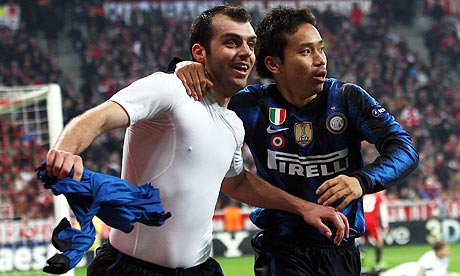
Welcome to my football blog. I'll be covering most of the key issues and stories which dominate top level English and European football over the coming months, and so if you love this fantastic sport as much as I do, I hope you'll appreciate reading and responding to what I've got to say.

Friday, 6 May 2011

Ancelotti's judgment on the line at Old Trafford

Chelsea's beleaguered boss must abandon the Fernando Torres experiment for Sunday's title decider, even if it costs him his job

Ancelotti's team selection may be crucial at Old Trafford as Chelsea seek to retain their title

Against all the odds, Chelsea once again find themselves in with a chance of winning a title they had done their very best to lose.

Arsenal’s defeat of leaders Manchester United on Sunday leaves Carlo Ancelotti’s side three points off the pace with an identical goal difference and with what Sir Alex Ferguson admits is a “massive chance” to frustrate United in their quest for a record 19th league crown.

With a decisive trip to Old Trafford to come this weekend, the Blues go into the final three games of the Premier League season knowing maximum points will almost certainly see them retain their title.

And this is all despite a wretched run which saw them record only five wins in 16 games between early November and mid-February,  and despite the fact that they have suffered seven defeats overall this term.

To describe this as an extremely difficult campaign for Carlo Ancelotti would be a considerable understatement.

Attempting to compete for domestic and European honours with a criminally thin squad of ageing stars against a backdrop of boardroom interference has proved a fool’s errand, and a belated £70million January transfer spree proved insufficient to deliver the Champions League trophy Roman Abramovich so greatly craves.

After all he has endured, it is likely Ancelotti will leave Stamford Bridge at the end of the season regardless of the result at Old Trafford on Sunday, either as yet another victim of the Russian billionaire owner’s well-worn axe or of his own volition.

And this is exactly why, having been presented with one last opportunity to lead Chelsea to an unlikely defence of their Premier League crown, the Italian must be bloody-minded, and disregard any prior deference to Abramovich’s vanity when picking the eleven players who will face United.

The presence of a misfiring Torres has created a huge problem for Ancelotti

I am talking, of course, about Fernando Torres, the £50million gift that just isn’t giving. It is the Spaniard who represents the biggest threat to the Blues’ chances of seizing the initiative in the title race this weekend.

Torres’ struggles over the last 18 months have been well documented, and there are countless theories which have sought to explain his drastic decline in form.

Protestations of unhappiness on Merseyside secured a big money move to west London, but if anything the 27-year-old has looked even more lost in his new surroundings, as he tries to adapt to a new system, new teammates and a new way of playing.

Ancelotti has tried gamely to find a style which brings the best out of his new frontman, but all have involved shoe-horning too many square pegs into round holes. Torres’ epic Chelsea drought may be over, but one goal from fifteen appearances remains a damning indictment of both player and manager.

Ancelotti recently described Torres in a press conference as ‘the present and future of Chelsea.’ He’s half right.
 
Having spent so much money on bringing in a world-class striker six years the junior of Didier Drogba, it is inevitable the powers that be at Stamford Bridge want to build the next great Blues side around the Spaniard.
 
Didier Drogba's improving form has been an key component in Chelsea's revival

But it is the Drogba, not Torres, who must lead the line at Old Trafford on Sunday. For starters, big name competition appears to bring the best out in him.

The big Ivorian responded to the arrival of Andriy Shevchenko in 2006 by scoring a then-career best 33 goals for Chelsea the following season, and Torres’ presence appears to have had a similar effect.

Drogba has still to hit top goalscoring form since contracting malaria in October last year, but he is the main reason why Chelsea have taken 25 points from a possible 27 in their last nine games despite never looking their imperious best.

With Drogba leading the line, Chelsea are a formidable attacking force. With Torres, they are a team carrying a passenger. If Ancelotti thinks any different, he would be well-advised to re-watch the tapes of his side’s Champions League exit at Old Trafford last month.

Chelsea looked toothless and sluggish for well over an hour of that game until their manager lost patience with Torres and handed Drogba the unenviable task of rescuing the tie inside the last 20 minutes. The 33-year-old did not succeed, but accomplished more in his brief cameo than Torres has since January.

United’s excellent central defensive partnership of Rio Ferdinand and Nemanja Vidic will feel no fear if they see the Spaniard’s name on the team sheet again on Sunday.

Nor is pairing the two together a viable option. On the occasions when it has been tried, the whole team has suffered.

Drogba and Torres have struggled to play together since the latter's January arrival

Playing two central strikers necessitates a narrow four-man diamond midfield and an over-reliance on the full-backs for width, and Chelsea have been found out very quickly by both United and Liverpool when playing this way recently.

Even on a purely footballing level, when they have been on the pitch together, Torres and Drogba have appeared at best incapable of playing together and at worst unwilling to try.

In such a situation, Ancelotti must go with the more effective choice. And, of course, Torres would still be a potentially dangerous one man 'plan B' if Chelsea are forced to go for broke late on at Old Trafford.

Chelsea will not necessarily win if Drogba starts on Sunday, but they will have a fighting chance. If Torres starts, all available evidence suggests they will lose.

After all he has seen over the past few weeks and months, it is almost inconceivable that privately Ancelotti has not reached this same conclusion, despite what he says in public.

Consequently, if he selects Torres to lead the line against United, it must be interpreted as an attempt to indulge the Chelsea owner to the detriment of his side's chances.

But any such attempt at indulgence would prove fruitless for the Italian. 

Roman Abramovich has shown himself to be a man who will not countenance failure, even if he has contributed to it. He has no record of showing mercy to his managers or even acknowledging his part in their downfall, and there is no reason to assume this will change.

It will be Carlo Ancelotti’s judgment, and probably his job, on the line at Old Trafford on Sunday. Therefore it is his own judgment by which he must abide.

Thursday, 28 April 2011

A tale of magic and madness at the Bernabeu

Physical confrontation was a recurring theme of Wednesday night's Clasico

Wednesday night’s Champions League semi-final clash between Real Madrid and Barcelona was certainly, and somewhat inevitably, not one for the purist – scrappy, aggressive, more drama than entertainment, more petulant chess match than a contest for the ages.

It was also an occasion which served to further highlight both the fantasy and folly which characterizes elite football in the modern era, and the ability of the world’s greatest footballers to excite and exasperate in equal measure.

But all who witnessed this unique spectacle will feel equally privileged to have yet another astonishing example of Lionel Messi’s irrepressible genius to savour.
 
Messi's two late goals look to have won the tie for Barcelona

To expect, or even hope for, a feast of football at the Bernabeu would have been optimistic to the point of naïve; last November’s 5-0 mauling at the Nou Camp had ensured this particular el Clasico was never going to be an open contest.

Any Madridistas who believed Mourinho would be willing take the game to Barcelona were served ample notice of the Special One’s real intentions in the last two meetings of the sides, in which he laid out the tactical masterplan he hoped would wreck the Catalans’ Champions League hopes.

On Wednesday Mourinho and his players, flushed with success in the Copa del Rey final, sought to harass and to stifle Pep Guardiola’s men once again, to deny space to the likes of Messi and Xavi and to intimidate their rivals with greater aggression and physicality.

And this tried and trusted strategy worked for well over an hour, ensuring a semi-final which pitted many of the world’s greatest footballers against each other never threatened to live up to its Hollywood billing.

Rather than breathtaking skill and flowing football, the recurring theme was instead one of cynicism and petulance, as both sides sought to trick and to pressure the referee into making a decisive call and, in doing so, to tip a delicately-balanced tie in their favour.

In such an environment, controversy was inevitable – and it duly arrived when Pepe was dismissed for what Wolfgang Stark deemed a high and reckless challenge on Dani Alves, who played the part of sniper victim admirably.

The decision proved vital. With Madrid’s Portuguese defender-come-midfield destroyer out of the picture, the brilliance of Lionel Messi was finally given the room to flourish, and it was the little Argentine magician who won the game for Barca with his 51st and 52nd goals of an astounding season.

The first was a reward for a committed and cleverly timed run to the near post when he met substitute Ibrahim Afellay’s pinpoint centre; the second showcased everything that makes a rampaging Messi the most thrilling sight in the world of football: phenomenal acceleration, devastating precision of touch and a cool finish.

This match-winning contribution by the world’s best player had threatened to mask the bitter taste left in the mouth by all that had gone before. But Jose Mourinho ensured this would not remain so, with a post-match rant which was a masterclass in generalization, overstatement and selective memory.

Mourinho's post-match comments are likely to be punished by UEFA

The Special One’s ridiculous allegations of a grand UEFA-endorsed conspiracy to ensure Barcelona remain at the pinnacle of the sport did not even represent the biggest crimes of his ill-advised monologue.  An examination of what he omitted provides far more grounds for criticism.

For in all of Mourinho’s railing against referees, he failed to condemn the persistant monkey chants Dani Alves was subjected to by Madrid fans following the Pepe incident, and for which one can only hope the club will be punished.

He failed to admit that his side’s physical approach and willingness to crowd the referee at every opportunity had left them open to the sort of red card eventually shown to Pepe, or that Marcelo and Sergio Ramos could easily have earned early baths for offences against Messi and Pedro.

And he failed to credit Barcelona’s number 10 for scoring what will surely go down as one of the great goals of the Champions League era.

Mourinho has regularly sought to question the decisions of officials after defeats in big games, often with the primary function of deflecting the attention away from his side’s poor performance, but raising doubts over the validity of this Barcelona team’s success just smacks of sour grapes.

The real reason why the Special One has had a man sent off in each of his last five meetings with Barca lies in the way in which his teams look to play.

If you cede possession to your opponents and seek to pressure them aggressively without the ball, you run a very real risk of attracting unwanted attention from the referee –  and even more so when the team you are playing is particularly adept at making every mistimed challenge look like attempted murder.

Madrid’s approach to the last three Clasico meetings has made a dismissal almost inevitable. Mourinho knew this, but he was taking a calculated risk.

Pepe's red card, rightly or wrongly, proved the turning point in the match

Real managed to win the Copa del Rey because they lasted 120 minutes before going down to 10 men. Had they lasted longer than 70 minutes on Wednesday, there is a strong possibility they would have held out for a 0-0 and gone to the Nou Camp knowing one away goal would put them in a very strong position.

But they didn’t. Madrid’s players were unable to walk the disciplinary tight-rope, and so now go into the second leg all but out of the tie. Despite Mourinho’s post match defeatism, Real will not give up in Catalonia, even though they are in an almost impossible situation.

Madrid must somehow beat Barca by two clear goals at the Nou Camp, without leaving the world's most deadly attacking force any room to hurt them in return. If Mourinho were to pull this off now, it would undoubtedly represent the most astonishing moment in a glittering managerial career.

The smart money is on Barcelona lining up against Manchester United, who have made even lighter work of Schalke in the other semi-final, at Wembley in May. 

Will United gain revenge for their 2009 humiliation in Rome? Or will this exceptional Barcelona side stamp their greatness even more indelibly on the annals of history? 

Whatever happens, just be grateful this wasn't the final.

Friday, 22 April 2011

A humble Madrid spells danger for Barca

Real Madrid have set their egos to one side and embraced "anti-football" in a bid to end Barcelona's domestic and European dominance. The Catalans now face a serious threat to their Champions League hopes

Wednesday's Copa del Rey victory gave Real their first trophy in three years

When Barcelona destroyed Real Madrid 5-0 at the Nou Camp last November, many observers - this writer included - struggled to find the words to do justice to the level of performance we had just witnessed, and to the team which provided it.

It was, for want of a better term, simply brilliant. The best team in the world had not only beaten the side widely accepted as being their closest rivals, they had annihilated them. Schooled them. Humiliated them. Yes, ‘brilliant’ will do.

But brilliance is dependent on circumstance. In football, brilliance is defined not only by the individual or team which produces it, but also by the deficiencies of the other individual or team which make that brilliance possible.

For every act of brilliance on the football pitch, there is a mistake, either technical or tactical, individual or collective, which enables it to happen. And after last November’s thrashing, no one knows this better than Jose Mourinho.

Of course, this Barcelona team are exceptional, and their five-goal Clasico demolition of Real deserves its place among the all-time greatest club performances.

But its greatness can be attributed to the fact that the likes of Messi, Xavi and Iniesta were allowed the time and space to exhibit their genius by a combination of Mourinho’s fatally misguided tactical plan and the naïve mistakes of a youthful Real side.

Give Barcelona the room to play and they will destroy you. The lesson was clear, delivered in the most emphatic way possible. The Special One would not need to be told twice.

Which is why last Saturday’s La Liga encounter at the Bernebeu marked a seismic shift in Real’s tactical approach to playing their great rivals.

Rather than trying to impose their own style and dominate Barca, the emphasis for Madrid was very much on stifling Pep Guardiola’s side with a mixture of high intensity pressure and a deep defensive line, only looking for opportunities on the counterattack.

It was what some would call “anti-football” – fundamentally destructive rather than constructive, and far more in line with the approach Mourinho’s Inter endorsed against the Catalans last year.

It was also an approach which drew criticism from many quarters, most notably from Barcelona legend Johan Cruyff and, perhaps more surprisingly, Madrid great Alfredo Di Stefano.

"We saw clearly that [Madrid’s] approach was not the right one. Barcelona were a lion, Madrid a mouse," the 84-year-old wrote in his column in Marca.

"Madrid were a team without personality. Barcelona play football and dance while Madrid just run back and forth constantly, tiring themselves out."

But there was something Di Stefano chose not to highlight, and it was perhaps was the most significant aspect of Saturday’s turgid 1-1 draw: It was the fact that, after five consecutive Clasico defeats, Real had not lost. They had been dominated, certainly, but not beaten.

Mourinho was also criticized for letting the title race die by settling for the draw but, with Barca already eight points clear and carrying the head-to-head advantage afforded them by that 5-0 win before Christmas, the Special One must have considered the title race over.

He had other priorities. To rebuild his players’ fragile confidence that they could at least compete with Barca, to give them the beginnings of a belief going forward into this unique four-game series against the Catalans that they could actually best their great rivals.

And it worked. Only four days after ending their losing streak, Madrid beat Barcelona by a solitary extra time goal in Valencia to triumph in the Copa del Rey final for the first time in 18 years. But even more significantly, they beat Barca the Mourinho way.

Cristiano Ronaldo and Pepe both played crucial roles in Madrid's victory
  
Unlike their first meeting in November, Real did not walk out onto the pitch for the Copa del Rey final seized by the arrogant delusion that they could match Barcelona blow for blow. Instead, they accepted they would lose the battle for possession, and so concentrated on defending tightly and deep in a bid to limit their opponents as much as possible.

The defensive midfield trio of Xabi Alonso, Sami Khedira and the excellent Pepe ensured there was almost no space for Barca to play tiki-taka football between the midfield and defensive lines, whilst Cristiano Ronaldo, Mesut Ozil and Angel Di Maria pressured high up the pitch in a bid to prevent the Catalans getting into their rhythm.

Mourinho's gameplan was not perfect, and Madrid still rode their luck at times. Iker Casillas rescued his team-mates with fantastic saves on a handful of occasions, and only Pedro's marginally ill-timed run ensured a moment of mesmerising genius from Lionel Messi did not get the reward it surely merited.

But for the most part Real managed to frustrate Pep Guardiola's men, and actually produced a number of clear opportunities of their own through lightning quick counterattacks. Cristiano Ronaldo finally found himself in a position to have a decisive influence over a Clasico, and took his chance brilliantly with that towering injury time header.

It wasn't pretty, but Madrid have finally found a way to beat Barca. All they have had to do is to set egos aside, accept their own footballing inferiority and discard high-held principles of entertainment to embrace "anti-football".

This may not sit right with purists in the Madrid hierarchy such as Di Stefano and Valdano, but Real fans are just grateful to Mourinho for stemming the tide of Catalan victories in the Clasico.

And of course, further glories could be ahead.

The Copa del Rey victory will give the Madrid players a huge psychological boost ahead of the two-legged Champions League semi-final to come, whilst Barca's realisation that the current Real is a much more streetwise and formidable beast than the one brushed aside so easily last November may just raise a little self-doubt.

The one final question which remains is whether Wednesday's extra-time exertions will have taken anything out of either side physically.

Barcelona have a frightningly small squad, an oversight which may yet cost them dear, but there is also a doubt as to whether Madrid can defend so perfectly for what will end up being over six hours of football in less than three weeks against the most fearsome attacking team in world football.

Only time will tell, but Real's victory has provided the best possible prologue to the Champions League semi-finals.

With a new, humble Madrid likely taking to the field next Wednesday, the spectacle is unlikely to match last November's magnificent exhibition. It will, however, be a genuine contest. 

Sunday, 10 April 2011

Champions League contenders flex their muscles

This week provided all the tension and drama you would expect from the quarter-finals of the Champions League, but also a remarkably high number of goals. Here's my take on the action.

Rooney gives laboured Chelsea the blues

Rooney's clinical 24th minute strike has put United in the driving seat

When the Champions League quarter final draw was made, it was predicted that this contest between England's two most successful teams of the past decade would be the closest to call.

And so it proved. In a week of high-scoring matches and apparently decisive first leg results, only Wayne Rooney's away goal midway through the first half separates Chelsea and Manchester United heading into next Tuesday's return at Old Trafford. But what a crucial goal it could prove to be, and what a time for United to record their first victory at Stamford Bridge since 2002.

As a spectacle it was at once uninspiring and yet absorbing, offering more in the way of drama than entertainment. This was perhaps to be expected, given the fact that both teams involved tend to overwhelm their opponents through sheer pressure rather than sheer invention.

Also unsurprising is that in such circumstances, it was a rare piece of invention which ultimately provided the only difference between the two sides. 

A pinpoint diagonal pass from a seemingly-rejuvenated Michael Carrick found the evergreen Ryan Giggs, whose unerring control and awareness allowed  everyone's  favourite foul-mouth Wayne Rooney the chance to once again demonstrate the electrifying talent which goes hand-in-hand with the idiocy he displayed at the weekend, and which makes his occasionally mindless aggression all the more frustrating.

It was a ruthlessly efficient away performance from United. Sir Alex Ferguson's players adhered to his gameplan to the letter, defending in numbers, pressuring high up the pitch and counter-attacking with the pace of Rooney and Hernandez. Testament to its success is the fact that, despite creating the fewer chances, the visitors consistently looked the more dangerous side going forward.

United's cause, however, was helped significantly by a turgid Chelsea display. The chronic lack of width, creativity and, most importantly, urgency in the hosts' attacking play meant they were unable to exert the kind of sustained pressure on the Red Devils' defence which sparked a stirring second half comeback when these two met in the Premier League last month.

David Luiz, both the hero and the villain of that encounter, was sorely missed in the Chelsea defence, especially since his presence would have enabled Branislav Ivanovic rather than Jose Bosingwa to fill in on the right flank - and one suspects the more defensively-minded Serb would not have let Giggs escape his attentions so easily for Rooney's winner.

Up front, the performances of Didier Drogba and Fernando Torres provided more ammunition for the argument that the two are at best incapable of playing together, and at worst unwilling to even try and make it work.

Both were bitterly disappointing on the night, but it was nevertheless surprising to see Drogba rather than Torres hauled off midway through the second half, given the big Ivorian still appeared to represent the Blues' best chance of an equaliser.

In spite of their struggles, Carlo Ancelotti's side could, and perhaps should, have scored, with Evra clearing off the line from Lampard and Van Der Sar denying Torres the first goal he desperately needs with an outstanding fingertip save. They will also feel rightly aggrieved to be denied what appeared a stonewall penalty in the last minute, as Evra hauled down Ramires in the box.

But such hardships cannot conceal a performance not worthy of a side which supposedly harbours genuine ambitions of being crowned kings of Europe.

The tie is far from over, but the Blues now face a massive task if their pursuit of owner Roman Abramovich's "Holy Grail" is not to end in failure once more. United will surely fancy their chances of seeing off the West Londoners at home next week and keeping alive their dreams of Sir Alex's third Champions League triumph.

Whatever the outcome at Old Trafford next week, the victor will most likely meet Schalke in the semi-finals after a quite astonishing night of football at the San Siro on Tuesday.

Schalke stun ragged Inter

Raul's 54th minute strike proved the turning point in a wonderful match

In one of the most entertaining Champions League matches of recent years, mid-table Bundesliga outfit Schalke proved they are not in the quarter finals simply to make up the numbers with an emphatic humiliation of defending champions Inter in their own back yard.

Such an outcome couldn't have looked less likely 20 seconds in, with Inter midfielder Dejan Stankovic catching Manuel Neuer off his line from all of 45 yards with a technically sublime volley to give the hosts the lead.

However, this piece of brilliance was eventually overshadowed by a brave and inspired performance from the German visitors, as they ruthlessly exploited glaring weaknesses in the Inter defence to score five away goals and all but book their place in the semi-finals for the first time in their history.

Just as Barcelona were commonly regarded as the "team to avoid" in the quarter-final draw, Schalke were the team everybody wanted to draw - largely because of their lack of star names and indifferent league form,  the latter of which recently cost Felix Magath his job.

But new boss Ralf Rangnick has galvanised the Bundesliga  underachievers in a few short days, bringing back players ostracised by Magath into the fold and seemingly getting the players to enjoy their football once more. And enjoy it they did on Tuesday, thanks in no small part to some truly criminal Inter defending.

The Serie A champions can rightly point to the fact that Christian Chivu & Andrea Ranocchia are not their first choice centre-back pairing, but rather one forced upon coach Leonardo by the absences of Lucio and Walter Samuel.

Nevertheless, conceding five goals at home is unacceptable in any circumstances, and now only the mother of all comebacks in Gelsenkirchen this Wednesday can preserve the Italians' hopes of becoming the first team to defend their title in the Champions League era.

Of course, any team which can boast the likes of Eto'o, Milito and Sneijder in it's offensive ranks cannot be completely written off. That said, under Rafa Benitez and now Leonardo, Inter have proven time and again this season that they are now the European champions in name only.

This is not the same team as the one which swept all before it under Mourinho last year - even if it does contain many of the same personnel - and also appears to be one which is in fairly urgent need of a freshening up.

Whether Leonardo will be the man given the time to undertake that task is no longer certain, with the Schalke humiliation following hot on the heels of a potentially decisive mauling in the Milan derby last weekend.

For Schalke, the immediate future looks somewhat brighter.

They have taken a big step towards the semi-finals of Europe's premier club competition for the first time in their history and, in Raul, they have a Champions League predator of the highest quality.

His well taken goal in the San Siro extends his lead at the top of the competition's all-time scoring charts to 14, and only the brave or the foolish would bet against him adding to his overall tally of 70 before this campaign is over.

If Schalke do make it into the last four, the Premier League's finest will write them off at their peril.

Spurs' dream becomes nightmare in Madrid

Crouch's 15th minute sending off left Tottenham helpless at the Bernabeu

Tottenham's maiden Champions League campaign has been going like a dream, but it took only 15 minutes to turn into a nightmare at the Santiago Bernabeu on Tuesday night.

Many observers had predicted the naivety of Harry Redknapp's side at elite European level might prove their undoing towards the business end of this tournament, and it was clear early on that this would be the occasion of Spurs' undoing.

Redknapp's gameplan would surely have been to sit deep, frustrate Real and attempt to use the pace of Bale and Lennon on the counter-attack to provide the service which would make good use of lone striker Peter Crouch's aerial prowess.

Such a plan was undermined from the very start - first by Aaron Lennon's late withdrawal from the match squad through illness, and then five minutes in when slack marking from a corner allowed Emmanuel Adebayor, so often the scourge of Tottenham with Arsenal, to power  a header over the line through the legs of Luka Modric.

Then came the naive mistake which did most to undermine the North Londoners' chances against Jose Mourinho's Real Madrid - and ironically, it came from one of the few members of the team who can boast significant Champions league experience.

Peter Crouch's two silly lunges on Sergio Ramos and Marcelo earned a deserved sending off, leaving Spurs a goal down and a man down with well over an hour to play against one of the most fearsome attacking teams in world football, and facing an impossible task.

Redknapp sought to defend and limit the damage, but Mourinho was determined to make the most of this opportunity, and his team's relentless pressure wore Spurs down. Adebayor's second header - making it 10 in 13 games against Tottenham - killed the game, and further strikes from Angel Di Maria and Cristiano Ronaldo killed of the tie.

It is to Spurs' great credit that they have been no respecters of big names and big reputations in the Champions League this year, but overcoming a four goal deficit against Jose Mourinho's Real Madrid looks too much of an ask for Harry Redknapp's talented team.

Such a comeback would surely be the greatest of all the great European nights at White Hart Lane, but it is inconceivable that a more defensively-minded Mourinho team would be so accomodating. The job looks done for Real, and a Clasico semi-final appears to be on the horizon.

"Below par" Barca crush Shakhtar

Dani Alves latched onto a fabulous Iniesta pass to double Barca's advantage

In the aftermath of Wednesday's clash at the Nou Camp, Pep Guardiola described himself as disappointed with what he called a 'below par' Barcelona performance.

His comments say more about the perfectionism which dominates the mindset of the Catalan club than the result, as an occasionally unconvincing Barca side nevertheless destroyed Shakhtar Donetsk 5-1 to pretty much book their place in the Champions League semi-final.

An arduous journey to Eastern Europe was thought to represent the biggest threat posed by the Ukrainian champions to Barcelona's chances of progress but, as some of us predicted might happen, the Spanish giants managed to kill off this 180 minute tie inside the opening 90 - and all without the steadying presence of Carles Puyol in defence or fit-again Lionel Messi ever reaching his inspired best.

Make no mistake: this was not the most convincing Barcelona home performance of the season. The Catalans looked defensively vulnerable with Sergio Busquets deputising at centre-back, and the worrying number of clear chances created by the visitors will prompt Guardiola to hope Puyol's return to action is a swift one.

Going forward, the deadly duo of Messi and Villa failed to ignite, but their manager will certainly be encouraged by further evidence of the depth of match-winning talent at his disposal.

With Barca's usual suspects enduring a rare quiet night, Andres Iniesta and Dani Alves stepped up in spectacular fashion.

Spain's World Cup winner gave his side the lead with a dead-eye finish two minutes in, and followed it up with an exceptional lofted pass through to Alves who, having broken the offside trap, rounded the keeper and finished with aplomb.

Second half goals from Pique, Keita and Xavi mean that despite Rakitskiy's goal for the visitors, Barca carry an unassailable lead to the Ukraine. Guardiola should be able to rest some of his big guns, safe in the knowledge that even a continuation of Shakhtar's formidable home record will not be enough to turn the tide.

Monday, 4 April 2011

Resilient United are worthy champions

Exceptional team spirit and resilience are the hallmarks of this United side

Sorry to be the bearer of bad news, folks, but the title race is pretty much over. 

Despite the fact that Arsenal and Chelsea will not, and indeed cannot, admit it, and despite Arsene Wenger and Carlo Ancelotti's unwavering public adherence to the mantra of "it's not over yet", it feels as though a choir of fat women ought to be bellowing their lungs out somewhere after this weekend's Premier League results.

How can I be so sure, you may ask, when the Gunners only trail leaders Manchester United by seven points with a game in hand, and when Sir Alex Ferguson's side still face tough tests against both of the sides chasing them in their remaining seven matches?

It might be because, since Arsenal haven't beaten United in any competition since November 2008, with  United emerging victorious in eight of the last 11 meetings between the two sides, I don't think much of their chances of beating the Red Devils at the Emirates next month.

It might also be because, despite what Carlo Ancelotti says publicly, Chelsea have accepted they are now too far off the pace to defend their Premier League crown, and so will focus their efforts on salvaging a disappointing season by finally satisfying owner Roman Abramovich's desire to win the Champions League - thereby possibly making May's league clash at Old Trafford a dead rubber, and reducing Arsenal's chances of getting the United slip-up they will require to become champions.

But it isn't.

Ultimately, the reason why I can see no destination for the Premier League trophy other than Old Trafford has become particularly clear for all to see in recent weeks, and it is this: No matter how unconvincing they may be or vulnerable they may look, this Manchester United team will simply not allow this title to slip through their fingers, and their rivals are incapable of prising it from their grasp.

The month of March provided the last real opportunity for Chelsea and Arsenal to seize the initiative in the title race. Two defeats in a week, at Stamford Bridge and at Anfield, threatened to derail United's inexorable progress towards a 19th league title, and the time was ripe for the chasing pack to ramp up the pressure.

Carlo Ancelotti's Chelsea did their bit, defeating the champions-elect, their 'noisy neighbours' and Blackpool to take maximum points from their three matches.

However, the horrendous crash in form they endured from November to February meant the Blues would always be fighting an uphill task to catch the leaders, and last week's draw at Stoke - while being far from the worst result of a difficult season - has provided the straw which breaks the camel's back in terms of their title chances.

If United's stutterings had momentarily left the door to the title slightly ajar for Chelsea, it had been swung wide open for Arsenal.

Had the Gunners beaten Sunderland and Blackburn at the Emirates and West Brom on the road - tough but limited opposition - they would currently trail Sir Alex Ferguson's men by a single point, as well as holding a game in hand over the leaders.

But the trauma of Carling Cup Final defeat to Birmingham at the end of February appears to  have sparked a fire which has engulfed the North Londoners' season and put paid to their trophy aspirations, with their only win in any competition in March coming in an FA Cup tie against Leyton Orient.

Arsenal's failure to turn up the heat on United in their moment of weakness means the Red Devils' lead at the top of the Premier League stands at seven points with seven matches remaining.

Although the Gunners can close the gap to four by winning their game in hand, any argument that they can still become champions rests on the assumptions both that they will drop less points than United between now and the end of the season and that they are capable of handling the pressure & adversity which must be overcome in a title race - assumptions for which there is little or no evidence.

Should United go on to win their fourth Premier League crown in five years, there can be no argument that they have done so partly as a result of the weaknesses of their rivals.

The inconsistency of Chelsea and Arsenal has been shocking and comical in equal measure at times, as has the lack of ambition shown by Man City boss Roberto Mancini, whose negative tactics and blinkered pursuit of Champions League qualification has stifled his side's ability to play a more active role in one of the most open title races of the past decade.

It is also undeniable that Sir Alex Ferguson's "Class of 2010/11" cannot compare, both in terms of individual or collective quality, either to the treble-winning vintage of 1999 or to the one which, propelled by the goals of Cristiano Ronaldo, dominated English football for three years from 2006 to 2009 and reached two consecutive Champions League finals.

In fact, all of the Premier League's established contenders - with the possible exception of Arsenal - have declined over the last two seasons, and emerging powers Man City and Tottenham have proved themselves not yet ready to mount a sustained domestic challenge.

But to use any of this to argue that no one deserves to win the title this year is just plain wrong.

Sure, this United side will most likely not go down as one of the greatest in the club's illustrious history, but this group of players does possess one particular quality which is truly remarkable, one which sets them apart from every other team in the land. I'm talking about resilience.

Resilience is not simply coming back from a goal or two to win a match, or bouncing back from a bad defeat one week with a victory the week after. It is a mental toughness, an unshakeable belief that whatever the scoreline, whatever the opposition, refereeing injustice or any other setback you may face, you can - nay, will - find a way to win.

United's January comeback win over Blackpool may prove a defining moment

It is a quality which has become synonymous with Manchester United Football Club throughout Sir Alex Ferguson's long reign as manager, but never has it seemed so firmly entrenched within the collective mindset as with the current playing staff at Old Trafford.

Of course, the reason for this could be that, because this United side are more vulnerable than their predecessors, resilience is called upon more than ever before to get them out of bad situations which individual or team errors have gotten them in to.

But, to a large extent, the nature of the explanation is irrelevant as far as the basic point is concerned: it is United's stubborn refusal to lose which has enabled them to keep their noses ahead in the Premier League title race, and it is this same stubbornness which looks increasingly likely to see them over the line.

Manchester United's "never say die" attitude has become the stuff of footballing legend, but this year it also has a basis in cold, hard, statistical fact.

The Red Devils have gleaned 22 extra points from the second half of Premier League matches this season having been in losing or drawing positions at half time, while surrendering just nine from winning or drawing positions - meaning they are 13 points better off in the table as a result of second half performances.

When the same calculation is done for Arsenal and Chelsea, it is found that the Londoners are only five and seven points better off respectively. On average, United's second half performances have given them seven extra Premier League points more than their main title rivals - and seven points just happens to be  the current gap between United in first and Arsenal in second.

But the significance of United's late rallies goes beyond merely points. Their psychological impact can be devastating. One cannot underestimate the effect knowledge of United's overturning of a two goal half time deficit at West Ham had on Chelsea prior to their draw at Stoke - where it was being broadcast on the stadium screens - or on Arsenal before their frustrating stalemate at home with Blackburn.

These comebacks also have a profound influence on the mindset of United's prospective opponents. The reputation which Sir Alex Ferguson's men have earned for finishing matches strongly means that, even when they find themselves in front, teams rarely believe they can close the deal against United.

Consequently, their natural tendency tends to be to try to protect their lead by defending deep in the last twenty minutes of the match, which inadvertantly makes them more vulnerable to the Red Devil's late attacking onslought. In short, United coming back to win has become a kind of self-fulfilling prophesy.

If the Premier League trophy does find its way to Old Trafford in May for a record 19th time, it will not be United's typically formidable home record which sticks in the mind. It will be the comeback victories  away from home over Blackpool and West Ham, the earning of a point at Aston Villa when all seemed lost, or Dimitar Berbatov's 88th minute winner over Bolton at Old Trafford which gave a ten-man United side a much-needed three points.

It will be the fact that all of this was achieved in spite of Rio Ferdinand and Antonio Valencia's lengthy absences through injury, in spite of the ageing legs of the remarkable Paul Scholes and Ryan Giggs, and in spite of the worst year, on the pitch and off it, of Wayne Rooney's career. It will be the overcoming of all this adversity which may serve to convince Sir Alex that his 12th league title as United boss may be among the sweetest of the lot.

By concentrating on the mental strengths of this United side, I have not intended to denigrate its technical qualities.

Wayne Rooney's star may not have blazed this season as it did last, but Nani and Dimitar Berbatov have matured into performers of match-winning quality, Javier Hernandez and Chris Smalling have made a decisive impact in spite of their tender years, and in captain Nemanja Vidic, United have probably the best centre-half in world football.

But, as the over-used sporting maxim goes, to win when not playing well is the sign of champions.

After 25 years at the top of the English game, no one knows this better than Sir Alex Ferguson. And it appears his current side know it too. They will win the Premier League, simply because they refuse to lose it. 

Monday, 28 March 2011

Welsh collapse tempers England praise

Bent's goal wrapped up the points for England after 14 minutes
It was confident. It was clinical. It was frustratingly unfulfilling.

There was much to commend about England's win at a sell-out Millennium Stadium on Saturday. The likes of Ashley Young, Darren Bent and Scott Parker all showed signs that they are finally feeling at home wearing the three lions, while Jack Wilshere offered further proof that he is not merely the future of the national team, but rather a key part of its present.

John Terry produced the kind of dominant and uncompromising display which lended weight to the arguments of both those who agree with Capello's decison to reinstate him as captain and those (like myself) who are of the view that he should never have been parted from the armband in the first place.

Capello's experimental 4-3-3 formation was also a pretty unqualified success, thanks in large part to prudent choice of personnel - the discipline of Parker allowed the more creative instincts of Wilshere to roam unchecked, while the attacking disposition of full-backs Cole and Johnson ensured England never lacked for width.

Above all, it was the steely resolve with which England took to their task in the opening moments which most impressed. In an intensely hostile atmosphere rife for intimidation, the visitors remained unbowed, and ruthlessly dispatched their opponents inside the first 15 minutes.

From the moment Darren Bent followed Frank Lampard's confidently taken penalty by sweeping home Ashley Young's cross, England never looked anything other than home and dry. The intensity among the players dropped off as they sensed victory; an instinct for self-preservation emerging as some of the Premier League's big names took the opportunity to conserve energy for crucial club battles ahead.

The only bum note struck from then on was the stupid booking picked up by Wayne Rooney for a needless foul on Joe Ledley, which rules him out of Switzerland's visit to Wembley in June.

But even that may eventually play out to England's advantage, for Capello will fancy his side's chances of seeing off the uninspired Swiss even without his star man, and suspension may grant Rooney the summer break he seemingly needs to emerge fit and firing from the most frustrating twelve months of his career to date.

After the bright opening in which the game was won, it was, in essence, a walk in the park for England. And that is the problem.

For the bottom line, harsh though it is, is this: England won convincingly and impressively, but against an opposition who were so passive, so toothless, so devoid of quality of any kind that it rendered the achievement almost insignificant. But it could have been so different. 

Gary Speed's young Wales team had a rare opportunity on Saturday. It was not simply a matter of pouring misery on 'the old enemy' in front of legions of their countrymen and heaping the pressure on Fabio Capello at the end of a week in which his stock had fallen even further with his ham-fisted treatment of the captaincy saga.

It was a matter of reassuring the Welsh fans after a disastrous start to Euro 2012 qualification that there is, after all, reason to be optimistic for the future of their national team.

It was a test which should have been a cause for Welsh inspiration; instead, it bred self-destruction - first through James Collins' clumsy hack on Ashley Young after the big centre-half had been caught badly out of position, and then through defensive organisation which wouldn't have looked out of place on the school playground as Darren Bent gleefully tapped home his third - and simplest - international goal.

Aaron Ramsey looked overburdened by the responsibility of captaincy in what remains early days after his horrific leg break last year. A bad combination of ring-rusty and overly-ambitious in possession, he toiled gamely throughout, but to no avail. There is little doubt the 20-year-old will grow into his new role, but a home nations grudge match against England was always likely to prove a baptism of fire.

And while much was made pre-match about the absence of Gareth Bale through injury, it is unlikely that Spurs' flying winger would have been able to significantly affect its outcome, no matter how devastating he has looked this season. That he would have significantly enhanced the threat of the Welsh attack is undoubted, but must also be tempered with the knowledge that the defence would have been no less porous in the face of English pressure.

If Gary Speed was under any illusions as to the size of the task facing him with the Welsh national team, he is perfectly aware now.

Out-thought, out-fought and out-played in each of their first four group matches and with their dreams of qualification already dead, the 41-year-old must now rebuild this young team's fragile confidence and try to create a new mood of optimism in the group before the race for Brazil 2014 begins. On recent evidence, it will be a long, hard road.

There is of course, the argument that England forced their opponents to play badly through superior organisation, pressure, and work rate. It is has an element of truth to it.

But Wales are a team ranked 116th in the world by FIFA. They had lost their opening three qualification games prior to Saturday's clash, and their starting XI was one which, aside from a few notable exceptions, consisted of players plying their trade in the football league. Such a team would require no great encouragement to play badly from the group of established Premier League names Fabio Capello was able to field. And, as it turned out, they didn't.

Victory at the Millennium Stadium, and the manner in which it was achieved, does not even consitute the best performance of England's qualification run thus far. Both the demolition of Bulgaria at Wembley last September and the triumph over Switzerland in Basel four days later were more comprehensive scorelines over teams vastly superior to Wales.

Those results failed to capture the public imagination for two reasons: firstly, because the games followed hot on the heels of the disappointment of South Africa and were achieved by largely the same team which had been responsible for it; and secondly, because any progress thought to have been made in those matches was quickly exposed as another false dawn by frustrating stalemate at home to Montenegro a month later, followed by a friendly defeat to France which was far more comprehensive than the 1-2 scoreline suggested.

Of course, there is plenty to suggest genuine progress is being made this time. Half the players in the squad Capello picked to face Wales were not involved at the World Cup.

Moreover, these new faces have not just been included to make up the numbers - Hart, Dawson, Wilshere, Young and Bent are making compelling arguments to become permanent components of the spine of the team, and it is to be hoped that the likes of Parker, Carroll and Adam Johnson can go on to do the same in the coming weeks and months.

But it is frustrating that Fabio Capello's brave new faces were not significantly tested on Saturday, and that the match could not tell us anything substantial about whether they or the tactics employed could work against more formidable opposition.

Perhaps Ghana at Wembley on Tuesday, friendly though it is, will provide a better indicator. What is certain, however, is that sterner examinations must be passed by Capello and his men if England fans are truly to be convinced that better times lie ahead.

Sunday, 20 March 2011

Champions League battle lines drawn

The Champions League quarter final draw conjured some intriguing ties
After all the backslapping, lovingly artful montages and tired you-have-all-earned-the-right-to-be-here-but-there-are-no-easy-matches-at-this-stage clichés had finally been dispensed with, UEFA General Secretary Gianni Infantino welcomed Gary Lineker on stage at the organisation's lush headquarters in Nyon, Switzerland, and got on with the business at hand.

The representatives of each of the remaining eight clubs in this year's Champions League looked on with baited breath, waiting to find out exactly what will be required if they are to emerge victorious at Wembley in May.

Now they know. As for the draw itself, it may have been a while in coming, but it was certainly worth the wait.

Both Ferguson and Ancelotti are looking for their third Champions League triumph
First up, its Chelsea versus Manchester United in a tie which is pure box office. Not only is it a rematch of the epic 2008 Champions League final in Moscow, it is also a duel between two genuine powerhouses who have, between them, dominated English football for the past six years.

Both sides will feel entitled to fancy their chances. United have been victorious on each of the previous four occasions they have been drawn against English opposition in the Champions League, and there are few coaches quite as experienced in Europe’s premier club competition as Sir Alex Ferguson.

But in Carlo Ancelotti, Chelsea can also boast a manager with considerable European pedigree. Roman Abramovich brought the 51-year-old Italian to Stamford Bridge 18 months ago primarily in the hope that Champions League success would soon follow.

That hope was dashed by Mourinho’s Inter last year, but victory over United in the league earlier this month has spread cautious optimism throughout the Chelsea ranks that Wayne Rooney and co. will not be the ones to end their European dreams this time around.

If Chelsea are to see off the threat of United, it will have to be without January arrival David Luiz, the star of that league win and the man who incurred Sir Alex Ferguson’s wrath for his unpunished manhandling of Wayne Rooney, as the fuzzy-haired Brazilian is not eligible to participate in the remainder of the Blues’ Champions League campaign.

However, potentially even more decisive for the outcome of the tie are the absentees in United’s defensive ranks.

The success which has enabled Ferguson’s latest generation to lavish an impressive collection of trophies upon the already creaking trophy cabinet at Old Trafford over the last four years has invariably had the imperious defensive partnership of Ferdinand and Vidic at its foundations.
 
This season, with the England captain struggling with persistent injury problems, it has fallen to Vidic to assume the sole responsibility of marshalling the Red Devils backline. It is a challenge he has risen to magnificently, putting in consistently match-saving performances as an infrequently convincing United have fought to maintain their place at the head of the Premier League title race.

All of which makes the inspirational Serb’s potential absence from the first leg at Stamford Bridge through injury a grave concern for Sir Alex. With Rafael and John O’Shea also out, United’s likely alternative – the promising but inexperienced pairing of Chris Smalling and Jonny Evans at centre-back and Wes Brown guarding the right flank – is not likely to intimidate even Chelsea’s misfiring attack.       

If Vidic does not take to the field at Stamford Bridge on 6th April, Chelsea will have an invaluable opportunity to take a big step towards the Champions League semi-finals. That said, Carlo Ancelotti’s men will have to overcome themselves before they can defeat their illustrious opponents.

Only in the last few weeks have the green shoots of recovery started to emerge in West London, after three months of relegation form which all but eliminated the possibility that the Premier League’s current champions will still be so come May. But despite recent signs of improvement, the Blues are still a long way from what will be required if they are to finally claim the trophy their owner so desperately desires.

One thing is certain: Chelsea’s revival needs to be swift. There is no hiding from the fact that Manchester United usually win at home when it really matters, and so Ancelotti’s side will likely not be able to settle for anything less than a victory in the first leg. If Ferguson’s men are able to take a positive result or an away goal back to Manchester, they will fancy their chances of seeing off their rivals while being roared on by a capacity Old Trafford crowd.

In any case, the team which emerges victorious from the tie will surely fancy their chances of featuring at Wembley in May, having been drawn to face the winner of Inter and Schalke in the semi-finals.

Inter Milan are the likely opponents for Chelsea or United in the semi-finals
The Italian giants have surely used up their allotment of fortune in defeating Bayern Munich in what was arguably the outstanding match of the last round. To their credit, Leonardo’s players also showed great resilience to come back against the Bundesliga champions after a first half in which they conceded enough chances to lose several matches.

This Inter are, however, simply not the same team as the one which swept all before them last season under Mourinho, even though most of those players remain. They are rightly favoured to defeat Schalke over two legs and advance to the semi-finals, but unless drastic improvements are made, both Chelsea and United would likely have the measure of the Serie A champions.

In fact, Inter's defensive vulnerability is such an issue that it would be foolish to rule Schalke out, and the Germans' impressive dispatching of an in-form Valencia side in the last round is proof enough of their capability to cause an upset.

But the Gelsenkirchen-based club appear to be in a state of crisis. Their wonderful achievements in Europe represent the only positive in an otherwise disappointing campaign which currently sees them languishing in 10th in the Bundesliga. 

Coach Felix Magath has already paid for this underachievement with his job, and although there is likely to be a new man in charge by the time the quarter-finals commence, the gut feeling is that Schalke may well find themselves out of their depth against the reigning European champions.

Rafael Van der Vaart will face former club Real Madrid in the quarter-finals
While it was the meeting of Chelsea and Manchester United which has got the most column inches in the national newspapers, it is the prospect of Tottenham facing up against Real Madrid which arguably does more to excite the imagination. 

Harry Redknapp's side are statistically the most exciting team to watch in the Champions League this year - there were, on average, five goals in each of their matches in the group stage - and although they showed a more conservative side against AC Milan in the last round, any team with Modric, Bale and Van der Vaart in its ranks will have no shortage of attacking intent. 

Spurs' impressive feat in claiming the scalps of both Milan giants also shows that, while this may be their first ever campaign in the Champions League, they are not intimidated or overawed by big names or reputations. It is a quality they will need again in spades - for as reputations go, they don't come bigger than Real Madrid. 

By pairing two of the most attack-minded teams left in the tournament, the the quarter-final draw has set up a mouthwatering new chapter in Tottenham's European adventure. It has also set up comfortably their stiffest test so far. 

Jose Mourinho's Real Madrid are an outstanding side. Prior to their 5-0 mauling at the hands of Barcelona, they were widely regarded as the second best football team on the planet. And although the praise has been slightly more reserved since then, Real remain a team consisting of world class players almost in every position, directed by the greatest tactician in the game. 

But they are far from invincible. For while the centre-back pairing of Ricardo Carvalho and Pepe has remained largely solid this term, the latter is occasionally prone to positional errors and bouts of indiscipline. Then there is also the fact that full-backs Marcelo and Sergio Ramos, for all the attacking threat they carry down the flanks, can occasionally be caught out defensively - a weakness which Gareth Bale and Aaron Lennon will surely look to exploit. 

Madrid are also, somewhat inevitably, over-reliant on Cristiano Ronaldo. The Portuguese superstar has scored an astonishing 37 goals and chalked up 12 assists in 42 appearances this season, but a hamstring injury threatens to keep him out of the first leg at the Santiago Bernebeu on 5th April. 

Ronaldo's absence could be crucial to Spurs' hopes of ensuring the tie is still alive when Real come to North London two weeks later. If they succeed in doing so, expect White Hart Lane to be rocking in anticipation of another great European night.

Even in the event that Harry Redknapp manages to best Mourinho - something he has so far failed to do in five attempts - Spurs' path to the final is likely to be blocked by the beautiful yet devastating presence of Barcelona. Well, unless Shakhtar Donetsk can achieve the mother of all upsets.

Are Shakhtar the team to derail the Barcelona juggernaut?
The Ukrainian champions are the ones unlucky enough to be facing the "side to avoid" in Friday's draw. But it may be surprising to learn that Pep Guardiola and his "dream team" are not overly keen on the prospect of facing Shakhtar either.

You see, Mircea Lucescu's men have previous with the Catalans. Paired together in the group stage of the 2008/9 tournament, Barca were made to work incredibly hard for a controversial win in the Ukraine before Shakhtar claimed a shock win in the Nou Camp. And, given that the personnel on both sides has changed little in the last two years, you can see why the La Liga champions are fearful of history repeating itself.

A two-legged tussle against Shakhtar entails a long and arduous trip to Eastern Europe and back for Barca, just at the moment when big games are coming thick and fast for them. Not to mention the fact that the Ukrainians are approaching the tie fresh from a pre-season break, whilst their opponents have been playing high-intensity football for over six months.

The caveat to all of this, of course, is that we must remember just how good Barcelona are. Shakhtar must journey to Spain for the first leg of the tie, and will have to travel better than they did against Arsenal in the group stage, when they were soundly thrashed 5-1. Messi and co. are more than capable of blowing Lucescu's team away at the Nou Camp and making the second leg a dead rubber.

But if they don't, things may just get interesting.